Hurricane Milton’s expected wake of destruction in the Tampa Bay area will likely lead to constraints in commodities and goods that are key inputs into sectors like agriculture, medical & surgical devices, and defense & aerospace.
Exiger identified over 50,000 companies that will be directly impacted by Hurricane Milton and at least 33,000 that will be indirectly impacted.
Agriculture
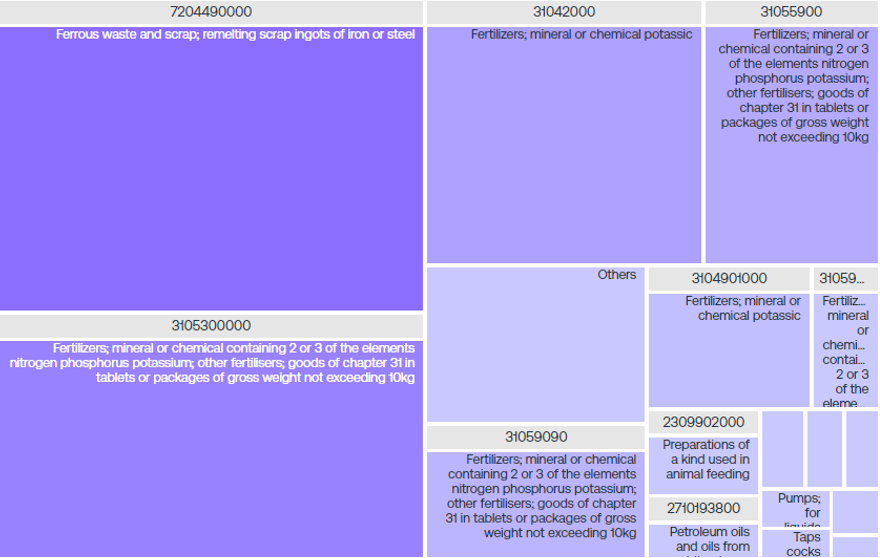
Fertilizers are a major commodity shipped from the Port of Tampa, representing a principal export by total value. In particular, the Tampa Bay area is an important source of fertilizer derived from phosphate. Although fertilizer prices have generally fallen since 2022, any resulting shortage could have a knock-on effect for food prices.
Breakdown of HS Codes by value:
Pharmaceuticals & Medical Devices
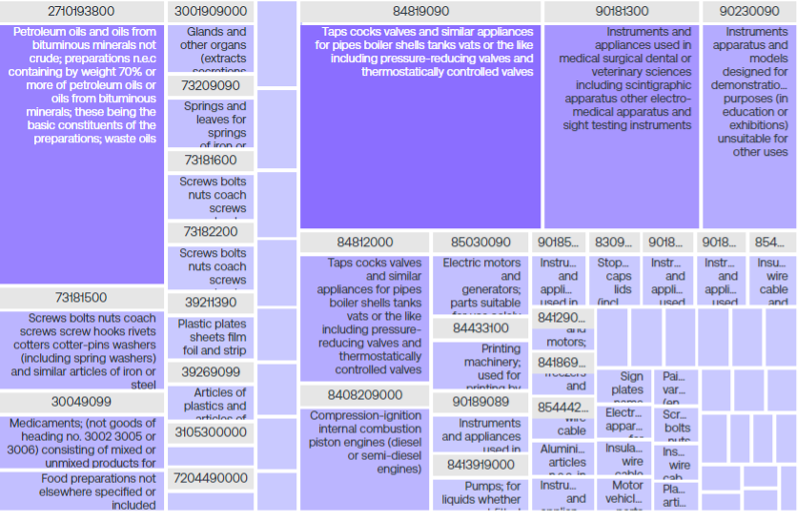
Pharma products and medical devices are also commonly shipped goods out of Tampa by volume of shipments. Facility closures from Hurricane Milton could worsen constraints that the industry is already facing from Helene.
Those constraints include a national IV fluid shortage. A little more than a week ago, medical supplier Baxter International Inc. had to temporarily shut down its production facility in North Carolina due to flooding from Helene. That plant is the largest U.S. manufacturer of IV fluids and peritoneal dialysis solutions; Baxter supplies 60% of the country’s IV fluid bags.
Per Exiger’s analysis of U.S. government (USG) contracts data, 20% of USG prime awardees that received awards performed in Milton “warning” and “watch” zones are categorized as “Medical, Dental, and Hospital Equipment and Supplies Merchant Wholesalers.” Damage from Milton could impact the supply of medical goods under these contracts and exacerbate the IV-fluid shortage.
Breakdown of HS Codes by number of shipments:
Defense & Aerospace
Over 12,000 U.S. government contracts performed in Tampa Bay area counties are awarded to companies for aircraft- or missile-related goods and services. Specific aircraft award product-and-service descriptions include airframe structural components; aircraft accessories & components; and aircraft hydraulics, vacuum, & de-icing systems.
At least four major U.S. defense contractors have manufacturing facilities in the Tampa Bay area.
Defense contractors operating in and around Tampa produce over 8,400 parts, with the most affected categories including hardware & abrasives, electrical & electronic equipment components, and aerospace craft & structural components. Of the 8,400 parts, 245 are sole-sourced — 48 of which are categorized as medical & dental equipment.
Although aerospace programs may be the most impacted in terms of sheer number of unique parts, shortages of critical, single-sourced medical equipment resulting from supplier closures could degrade force readiness and hamper recovery efforts.
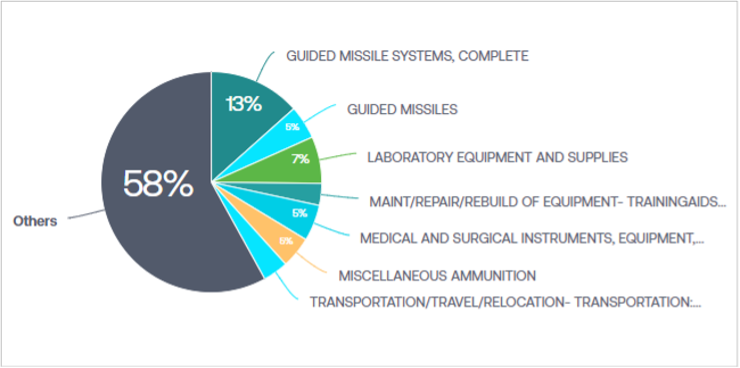
Breakdown of Prime Awards by product or services description & total amount obligated: