
As the world adopts varying degrees of acceptance towards the crypto ecosystem, Singapore has positioned itself as a crypto-friendly environment. Crypto.com, Triple A Technologies, and Independent Reserve are amongst the many Virtual Asset Service Provider (VASPs) drawn to the Lion City’s strong economy, stability, and high rate of cryptocurrency adoption. These favorable conditions for VASPs have unsurprisingly landed the country top spot as the ‘World’s Most Dynamic Crypto Country’ in a ranking by Coincub. Cognizant that this transformative digital technology can unlock new economic value, Singapore endeavors to expand its digital asset capabilities and further develop the Web 3.0 ecosystem.
Stringent Crypto Regulations
Notwithstanding its ambitions to be the global capital for crypto, Singapore is mindful of the risks associated with the industry. As a nation of diminutive size, it has a vested interest to safeguard its financial services sector, strong international position, and global trust it has conscientiously built over many decades. The country’s crypto-friendly messaging is supplemented with an increasingly stringent regulatory environment that has seen companies like Binance, FTX, and Huobi exit the city. Despite these departures, Singapore remains firm on its commitment to being a responsible global crypto hub that allows latitude for innovation. The Monetary Authority of Singapore (MAS)’s rigorous digital token payment licensing process is testament to the country’s commitment to weed out bad actors and attract only VASPs with strong risk governance and risk management capabilities. Events in recent years such as the collapse of crypto exchange FTX and investigation into crypto lender Hodlnaut further incites an already present tendency to prioritize risk management. Till date, just 18 companies out of over 200 applicants have emerged successful in obtaining licenses or in-principle approvals. MAS has conveyed its expectations on licensees to maintain strong governance structures and proven track record.
Anti-Money Laundering / Counter-Terrorism Financing (AML/CTF) Requirements
Amongst the risks in the crypto space, MAS, like other global regulators, has explicitly highlighted money laundering and terrorism financing (ML/TF) as a key risk. Determined to prevent criminal activities within its borders, Singapore subjects VASPs to the same AML/CFT measures as traditional fiat currencies. Further, with the passing of Part 9 of the Financial Services and Markets Bill in April 2022, VASPs registered in Singapore but only providing services abroad have also entered into the regulatory scope of the MAS for AML/CTF regulations. MAS’ AML/CTF risk management standards are described in Notice PSN02 - Prevention of Money Laundering and Countering the Financing of Terrorism (Digital Payment Token Service). These requirements closely mirror expectations set by the Financial Action Task Force (FATF), the AML/CTF global standard-setting body who first released guidance requiring VASPs to be regulated for AML/CTF in June 2019.
MAS has set our its expectations in four broad categories:
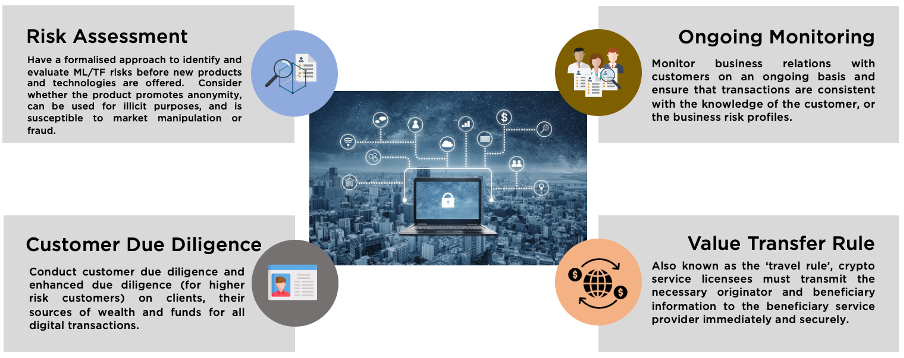
To avoid a licence rejection or revocation, existing crypto licensees in Singapore and interested applicants must adhere to the high standards set by the MAS. With the regulator’s explicit stance on keeping a keen eye on AML/CTF adherence, VASPs need to remain compliant and be a step ahead of bad actors by ensuring that they have adequate policies, procedures, and controls.
Undeniably, such complex and comprehensive regulatory environment presents immense challenges for stakeholders. Many crypto service providers have been regarded as novices with limited experience of being regulated. Unlike traditional financial institutions, the fundamental absence of a centralized counterparty makes it difficult for crypto platforms to be regulated to a consistent standard, and some see regulations as antithetical to the free-flowing spirit of the crypto space. While this is expected to converge over time, imposing expectations of a traditional financial institution on the relatively inexperienced VASPs means much needs to be done to bridge the culture gap. The regulator must provide practical guidance and support for the industry players. At the same time, VASPs must continue to innovate within acceptable risk boundaries as they achieve greater size and scale, while maturing their culture of compliance.
How Exiger Can Help
Exiger is a global regulatory and financial crime, risk and compliance company that combines its purpose-built technology and practical expertise to arm clients with modern solutions. Its award-winning tech leverages the power of artificial intelligence to illuminate and manage risks, helping stakeholders focus resources on what is most important.
Exiger has extensive experience working with entities within the crypto industry, financial institutions, corporates, and regulators worldwide. The company is also a trusted partner of the Travel Rule Universal Solution Technology (TRUST), a Travel Rule compliance solution for global cryptocurrency entities founded by a group of well-established firms active in cryptocurrencies. Exiger’s partnership with regulators dates back to 2013, when the company led the largest corporate monitorship in history. More recently, this has included several large-scale projects with the United States Federal Government. Exiger’s extensive experience places the company in an ideal position to support stakeholders within the crypto industry in navigating their compliance obligations.
Countries such as Singapore have much to offer VASPs, but only those who operate in accordance with legislative requirements stand a chance to succeed. With the regulator’s powers being extended to VASPs providing services both locally and abroad, observance of AML/CTF requirements are inevitable to those who wish to enjoy the fruits of Singapore. The risks accompanying this promising blockchain technology and flourishing sector cannot be ignored, and regulations will continue to be an inevitable part of its future. Compliance and risk management does not have to be a costly or timely endeavor. Instead, it can steer the business safely, enable financial innovation within the sector, and enable firms to realize operational efficiencies to gain further legitimacy and achieve their financial objectives.
Contact us today to discuss how Exiger can help you navigate AML/CTF requirements.
This client alert was produced by Cassandra Quek (Consultant) in Exiger’s Financial Crime Advisory team.