
Supplier risk management is moving from monitoring toward autonomous response.
Will your supply chain be ready in five years? Gartner predicts that by 2031, 60% of supply chain disruptions will be resolved without human intervention as AI enables increasingly autonomous supply chains. This year’s Supply Chain Symposium/Xpo agenda centers the conversation on AI, visibility, resilience, and faster decisions under pressure. For supply chain leaders heading to Barcelona, the question is no longer whether supplier risk management needs to evolve; it’s how quickly their teams can move from alerts and analysis to coordinated action.
Schedule time to meet the Exiger team at Gartner Supply Chain Symposium/Xpo 2026 in Barcelona and check out our speaking sessions. You can also visit us at Booth 520.
Here are five shifts that we at Exiger see most likely to shape that conversation.
1. Supplier risk management is moving closer to core operations
The expert line-up makes clear that AI, resilience, and transformation are now part of the same discussion. Supplier risk management can no longer sit on the edge of the business as a compliance review, a sourcing checkpoint, or an alerting function. Executives must anticipate several types of supply chain disruption while simultaneously balancing a broader rethink of how supply chains operate in an AI-shaped environment.
In its current state, many organizations still manage supplier risk through separate teams and separate motions. Procurement owns supplier continuity. Compliance owns sanctions, forced labor, and regulatory exposure. Logistics monitors disruption. Finance tracks cost pressure. Each team sees part of the issue. Few see the full supplier risk picture at the speed required.
That gap now shows up in daily operations. A tariff change affects sourcing. Then it affects compliance. Then it affects cost. A weather event affects service levels. A cyber issue buried in a dependency affects physical operations. Supplier risk management now must connect these threads faster and more consistently than many organizations are set up to do.
2. Geopolitical and regulatory pressure now sit inside supplier risk decisions
Geopolitics is no longer background context; it’s part of the supplier risk decision itself.
Tariffs, sanctions and export controls, and industrial policy now shape supplier selection, country exposure, and continuity planning. The Symposium agenda makes clear that cost pressure, shifting geopolitics, and AI-driven change now belong in the same strategic discussion for supply chain leaders.
This is a point Exiger CEO Brandon Daniels underscored in his World Economic Forum Risks by the Numbers remarks at Davos earlier this year. Supply chains are now one of the first places geoeconomic competition shows up operationally. Companies are already adjusting suppliers, routes, and country exposure in real time, often without full visibility into where risk entered the chain or how far it extends. Tariffs reshape sourcing decisions, sanctions interrupt goods in motion, illicit transshipment thrives where visibility breaks down, and critical material scarcity begins constraining growth well before demand peaks.
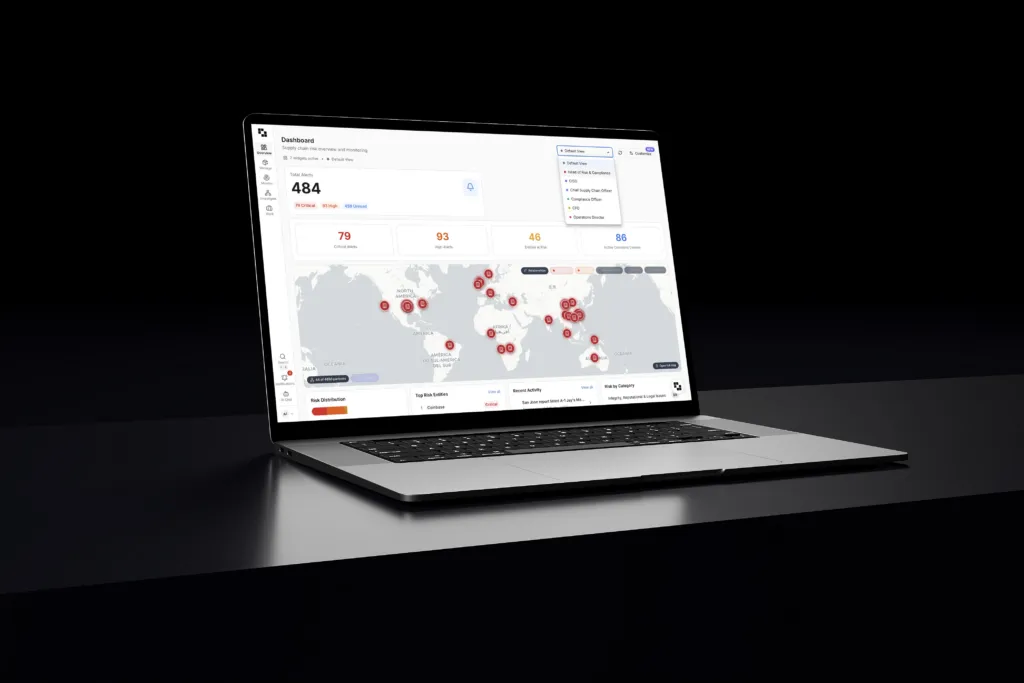
This is one reason technology now must be part of the supplier risk response. When geopolitical and regulatory conditions move this quickly, point-in-time reviews and manual coordination are too slow. Organizations need a way to understand supplier exposure across the full network and respond with more speed and precision.
3. Visibility is only the starting point
Most organizations know they need supplier visibility. The harder problem is what to do with it. Even when tier-one suppliers are well tracked, teams often lack a clear way to identify where risk sits, what matters most, and when to act.
The problem isn’t just missing data—it’s fragmented ownership, shallow mapping, and limited ability to take action on what teams already suspect.
Our on-demand webinar Extending Visibility Beyond Tier 1 takes a deeper dive to help teams identify critical suppliers and decide where intervention is warranted, which then reveals another issue: supplier risk is not evenly distributed.
4. Concentration risk often sits at the narrow points of the supplier network
Many organizations still picture supply chains as pyramids that broaden upstream. In practice, they often narrow into a small number of critical materials, specialized facilities, constrained geographies, or hard-to-replace capabilities. Exiger describes this as the difference between pyramids and diamonds: with diamond-shaped supply chains, value and vulnerability often concentrate at the narrow points.
Pressure exposes the narrow points quickly. Geopolitical strain, trade disruption, regulatory scrutiny, and material scarcity can turn seemingly manageable dependencies into concentrated operational, financial, or compliance risk. That’s why supplier risk management is not about building the largest possible map, it’s about identifying what is truly critical and where action is still possible. Visibility matters when it helps teams identify concentration risk early enough to qualify alternatives, adjust sourcing, engage suppliers, and avoid being locked into a shrinking set of choices.
5. AI has to improve response, not just analysis
This year’s Gartner Magic Quadrant for Supplier Risk Management Solutions and the Supply Chain Symposium agenda both illustrate a market moving past introductory AI enthusiasm.
Initial use cases focused on summarizing documents, classifying signals, and automating isolated tasks. Those capabilities still matter, but supplier risk teams are now asking a more practical question: does AI help them connect signal to action across teams, systems, and decisions?
AI will function less as a reporting layer and more as an execution layer, with agentic workflows handling parts of the work that usually slow teams down: gathering context, routing tasks, escalating issues, and supporting response once a risk signal appears.
That is the more useful test for AI in supplier risk management: the value is not in generating more output. It is helping teams identify what matters, escalate sooner, and move faster once action is required.
The bigger supplier risk question
Taken together, these shifts point to one larger issue. The market now expects supply chain leaders to manage supplier risk differently: with better visibility into critical dependencies, stronger coordination across functions, and more effective use of AI where disruption, regulation, and cost pressure intersect.
Most supplier risk teams can detect more than they can act on. The harder challenge is the handoff from signal to response: who owns the issue, which suppliers matter most, what happens first, and how quickly the organization can move before disruption narrows its options.
That is the question heading into this year’s Symposium: whether the way organizations manage supplier risk is evolving as quickly as the environment around it.
Schedule time to meet the Exiger team at Gartner Supply Chain Symposium/Xpo 2026 in Barcelona and check out our speaking sessions. You can also visit us at Booth 520.