
What Is Transshipment?
In global trade, transshipment is simply defined as routing cargo from a country of origin through an intermediate country to a destination country. Some transshipment is routine and legitimate – goods are often transferred between ships or routed through third countries as part of normal logistics operations.
But not all transshipment is benign. Illicit transshipment occurs when goods are deliberately rerouted through intermediary countries or facilities to conceal their true origin. This practice, sometimes referred to as “Rule of Origin washing,” is commonly used to evade tariffs, Antidumping and Countervailing Duty (AD/CVD) restrictions, sanctions, and other trade restrictions like forced labor import bans. Transhippers exploit opaque supply chains and foreign investment structures to conceal this activity, resulting in lost tariff revenue for governments and hidden compliance, reputational, and security risks for the industry.
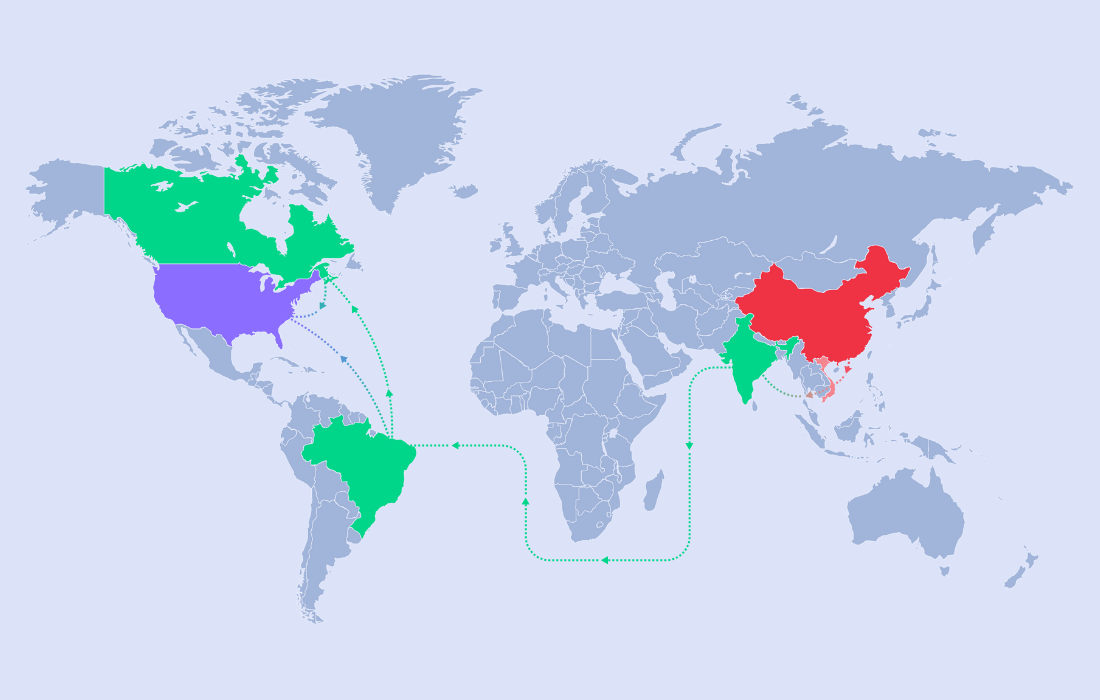
Illegal transshipment undermines fair competition, threatens economic security, and places corporations at risk of regulatory exposure. This reality makes transshipment detection essential.
What Does Transshipment Mean for Trade Enforcement in 2025?
Today’s enforcement environment demands more than traditional audits and must include rigorous transshipment risk management. Regulators are modernizing customs enforcement to ensure lawful trade, protect consumers, and defend American industry. Companies that lack visibility into their supply chains risk unknowingly facilitate unlawful imports – with steep financial, legal, and reputational consequences. In 2025, the U.S. Government has taken several measures to increase transshipment detection and tariff evasion detection:
- Created the Department of Justice (DOJ) and Homeland Security (DHS) Joint Trade Fraud Task Force to target importers that seek to evade tariffs and other trade laws (e.g. The Uyghur Forced Labor Prevention Act, or UFLPA).
- Issued the Executive Order and Presidential Memorandum on America First Trade Policy that empowers the entire U.S. government to identify and mitigate trade violators.
- Announced CBP operations targeting $400 million in illegal transshipments under the Enforce and Protect Act (EAPA).
How Exiger Protects Supply Chains from Hidden Compliance Risks
The Exiger Transshipment Intelligence Solution delivers regulator-grade visibility into global trade flows, helping companies meet the same standards used by enforcement agencies. Our framework leverages billions of shipment records, entity resolution across hundreds of millions of organizations, and AI-powered anomaly detection to reconstruct trade routes at a granular, transaction-by-transaction level. By linking shipments to ultimate beneficial owners and detecting ties to state-owned enterprises, sanctioned parties, or forced labor risks, Exiger equips compliance and procurement teams with the intelligence they need to stay ahead of enforcement expectations. This enables corporations to detect transshipment risks and identify illicit rerouting, suspicious ownership structures, and potential tariff evasion or rule of origin violations with the same precision that informs government enforcement actions.
The Exiger Transshipment Intelligence Solution not only helps ensure lawful trade and regulatory alignment but also equips clients with a defensible, auditable foundation for engaging with regulators, auditors, enforcement personnel, and policymakers on the integrity of their supply chains.
Transshipment Intelligence equips organizations to:
- Use the same trade intelligence and tools used by government regulators.
- Detect and mitigate illicit transshipment before it enters your supply chain.
- Strengthen compliance programs against evolving trade enforcement rules.
- Protect brand reputation, safeguard revenue, and reduce enforcement risk.
- Contribute to the integrity of the global trading system.
Get Started
Illicit transshipment is no longer a hidden loophole — it’s a top enforcement priority. Exiger gives you the intelligence to stay ahead. Request a demo to see Transshipment Intelligence in action.
Table of Contents
Get in Touch
Learn how you can build a more resilient supply chain.


