● Episode 06

McDonald's, Not Microchips: New Rules of Trade with China

With Michael Sobolik - Senior Fellow, Hudson Institute

With Kit Conklin

In Episode 6 of Exiger Exchange, Kit Conklin speaks with Michael Sobolik of Hudson Institute about where CEOs should draw the line between commercial growth in China and exposure to critical technology, infrastructure, supply chains, and capital markets. 

“We realize that unmitigated cooperation and engagement is not producing the outcome that American leaders hoped it would a few decades ago.” 

- Michael Sobolik, Senior Fellow, Hudson Institute

The Conversation

America does not need to stop selling McDonald’s hamburgers in China, but the West does need to think differently about derisking critical supply chains, capital markets, and trade. In this episode, Hudson Institute Senior Fellow and author Michael Sobolik joins Kit Conklin to examine the uneasy balance between U.S.-China economic engagement and strategic competition. From the ongoing trade detente to the Trump-Xi summit and new economic security restrictions, the conversation explores where CEOs should draw the line between pursuing growth in China and protecting the technologies, infrastructure, and industrial capacity that underpin U.S. and Western national security.

Kit Conklin, Global Head of Risk & Compliance at Exiger

Kit Conklin

Chief Strategy & Global Affairs Officer, Exiger

Kit Conklin is a seasoned expert in technology, policy, and national security. He served as a Senior Advisor to the U.S. House Select Committee on China and is a Nonresident Senior Fellow at Atlantic Council.

Michael Sobolik

Senior Fellow, Hudson Institute

Michael Sobolik specializes in U.S.-China relations, great power competition, net assessments, and competitive strategy. He is the author of Countering China’s Great Game: A Strategy for American Dominance and has worked on Indo-Pacific policy in think tanks and in the U.S. Senate.

Key Watch Areas

Where Economic Engagement Meets Strategic Exposure

For years, companies could treat China strategy mainly as a growth question. That is no longer enough for sectors tied to advanced compute, data centers, critical infrastructure, pharmaceuticals, rare earth magnets, and other strategic inputs. The question now is more specific: which relationships are ordinary commerce, and which ones create dependencies that matter to national security? 

The McDonald’s vs. Microchips Line

Some trade should continue because ordinary commercial engagement benefits U.S. companies and consumers. The harder question is how to restrict high-end technology and strategic inputs without closing off every market relationship. 

1260H as an Early Risk Signal

The Chinese military companies list does not automatically ban business with every named company. But it can still signal where U.S. government scrutiny may move next, making it relevant for compliance, investment, and supplier risk teams. 

AI Compute and Data Center Exposure

Advanced chips, AI model training, data centers, and influence operations are now part of the same competition. Companies need to understand not only direct counterparties, but how technology can be diverted, controlled, or used. 

Hidden Supply Chain Choke Points

Pharmaceutical ingredients, critical minerals, rare earth magnets, and other inputs can create concentration risk several tiers below the surface. Leaders need visibility before a policy change or geopolitical shock exposes the dependency. 

Visibility Into Action

Identify and Act on China-Linked Supply Chain Risk Before It Becomes Disruption

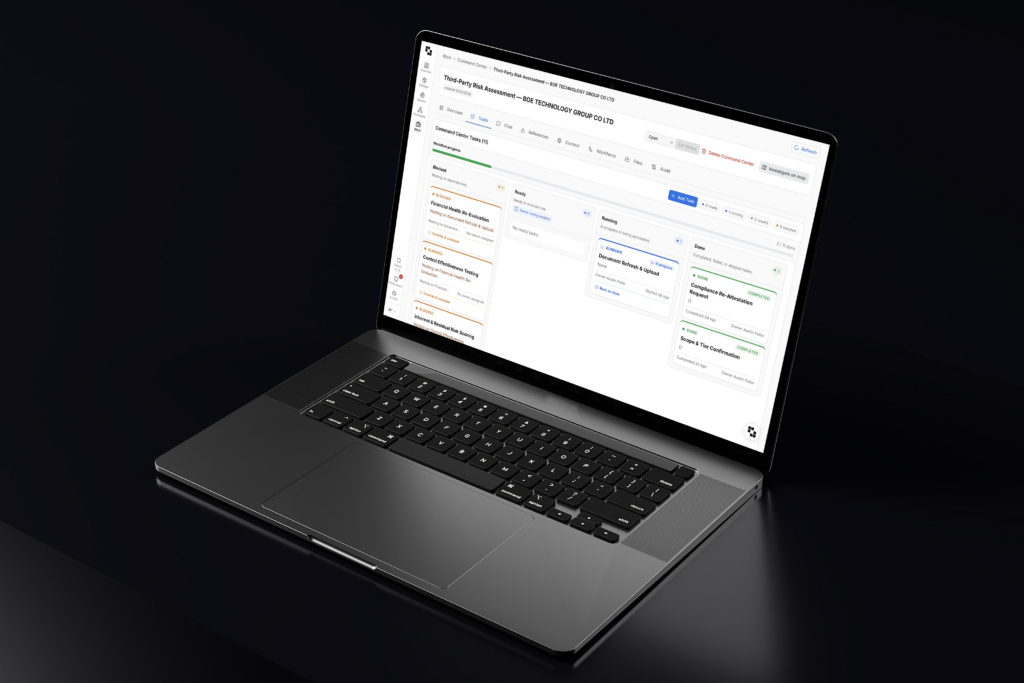
The 1ExigerAI platform helps supply chain and national security practitioners identify, assess, monitor, and act on supplier and third-party exposure across companies, products, materials, components, facilities, and geographies. That visibility helps organizations connect policy changes, economic security signals, and emerging supplier risk to the operational decisions that protect continuity, compliance, and resilience. 

Exiger AI command center dashboard showing third-party risk assessment tasks, workflow progress, blocked and completed activities, and centralized case management.

stay connected

Subscribe to Exiger Exchange

Follow Exiger Exchange for conversations on supply chains, economic security, national security, and the financial systems shaping global organization risk.