In Episode 3 of Exiger Exchange, CEO Matt McKnight joins Exiger Exchange to talk about the next frontier of national security: biology. Matt explains how advances in AI and bioengineering are changing the risk landscape, why governments and companies need “bio threat radar,” and how biological intelligence could become a critical input for supply chain resilience, public health, and national defense.
“The biological information of the planet is the last high-fidelity information resource humans haven’t organized and figured out how to use for decision-making purposes.”
- Matt McKnight, Founder, Perimeter
The Conversation
In this episode: as biotechnology and AI accelerate, the absence of large-scale biological threat detection is creating a growing blind spot. We also cover China’s biotech ambitions, the reshoring of critical medicine supply chains, and why the future of national security may depend on how quickly we can detect, attribute, and respond to biological risk.
Kit Conklin
Chief Strategy & Global Affairs Officer, Exiger
Kit Conklin is a seasoned expert in technology, policy, and national security. He served as a Senior Advisor to the U.S. House Select Committee on China and is a Nonresident Senior Fellow at Atlantic Council.
Matt McKnight
Founder, Perimeter & Former Head of Biosecurity, Ginkgo Bioworks
Matt McKnight is a Marine Corps veteran and former CCO of the now publicly-traded Gingko Bioworks. Matt’s new business is a unicorn called Perimeter, a company focused on defending against biological threats. In this episode, we discuss why biosecurity is starting to look a lot like cybersecurity did in the 1990s – an untapped market, misunderstood, and about to become essential.
Squeezed Supply Chains
The three places where the absence of BIOINT data already has operational consequences.
Geographic Risk
Early biological threat signals can emerge well before disruptions appear in traditional supply chain data. Organizations with sourcing concentration in high biological-risk regions are making inventory and continuity decisions without that visibility.
Manufacturing Operations
Wastewater monitoring can reveal workforce health risks before they appear in absenteeism or production data. By the time a factory manager sees the problem, it has already compounded. The lead time provided by environmental sensing is not available through traditional HR or ERP systems.
Pharmaceutical Supply
The U.S. pharmaceutical industry, particularly biologics and genetically engineered drugs, is undergoing significant change. As the dominant buyer of innovative drugs, the U.S. government can reshape where the industry invests by mandating domestic manufacturing—without creating a new spending program.
Key Watch Areas
What Government and National Security Clients Should Be Tracking
01
The Biological Intelligence Gap
For government clients, the implication runs deeper than supply chain continuity. McKnight’s argument is that biological capability has crossed into its engineering epoch — and the institutional architecture for managing it has not. Every other national security domain has a corresponding technical collection infrastructure: satellite constellations for missiles, global monitoring for nuclear activity, decades of SIGINT and GEOINT capability built into the fabric of U.S. intelligence. Biological threats have none of this equivalency.
02
COVID and the Cost of Missing Data
McKnight frames COVID’s unresolved origin as the defining evidence: he calls it the worst U.S. intelligence failure since 1941. The comparison is deliberate. Pearl Harbor was a failure to act on a signal the radar had already captured. The biosurveillance failure is structurally different — the radar was never built, which means the collection data that would have answered the origin question conclusively was never generated. That gap has direct implications for any government program responsible for health security, industrial base resilience, or threat characterization.
03
Gray-Zone Biological Threats
The more near-term concern, in McKnight’s framing, is gray-war use: biological capability deployed at low intensity, layered with disinformation, designed to impose economic costs without triggering a declarable response. Attribution in that scenario is functionally impossible without prior environmental baseline data. The organizations and agencies now building that baseline — including through the BioThreat Radar program at CDC, State Department forward-deployed biosurveillance, and the National Security Commission on Emerging Biotechnology (NSCEB) legislative agenda — are creating the preconditions for a collection capability the U.S. does not currently have.
04
The Open Policy Window
For government clients managing third-party risk, supply base visibility in critical sectors, or compliance obligations tied to industrial base security, the policy window matters. The FY2026 budget proposed $52 million for a CDC BioThreat Radar Detection System. Pharmaceutical procurement legislation is being advanced by the NSCEB. State Department programs are repurposing USAID funding for forward biosurveillance. Organizations with the supplier and third-party visibility to connect policy changes to operational exposure will be better positioned to respond.
Reframing the Risk
It's not just public health: Biological risk is an intelligence problem.
McKnight’s case is that biological risk should be treated as an intelligence discipline: a technical collection domain that generates continuous environmental data and is processed fast enough for a supply chain manager, a procurement officer, or a national security analyst to act on before the event compounds.
Early Warning
Biological threat detection creates visibility before traditional supply chain indicators begin to change.
Decision Time
Earlier signals give organizations more time to assess risk, evaluate options, and plan a response.
Operational Continuity
Proactive action can reduce the impact of disruptions on inventory, suppliers, and business operations.
Risk Intelligence
BIOINT shifts biological risk detection from reactive reporting to continuous intelligence collection.
Visibility Into Action
Identify & Act On Biological Risk Before Disruption Occurs
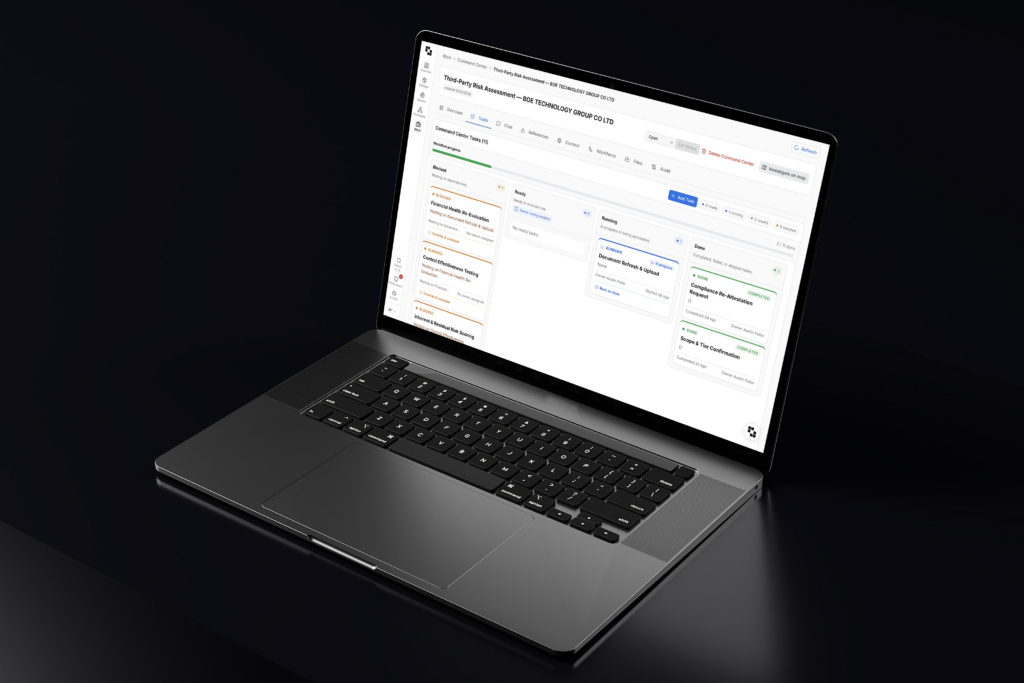
1Exiger.AI gives supply chain and national security practitioners the visibility to identify, assess, and enable autonomous action on third-party and supplier risk across the full scope of their exposure — including the geographies, sectors, and supply relationships where biological risk is emerging as a primary threat vector.
Follow Exiger Exchange for conversations on supply chains, economic security, national security, and the financial systems shaping global organization risk.