Detecting Undeclared Sanctioned Hardware via Firmware Analysis

Case Study
September 30, 2025
Detecting Undeclared Sanctioned Hardware via Firmware Analysis

Challenge

While investigating potential risks involved in introducing a popular industrial communications device into a high-assurance environment, a security researcher was seeking attribution and provenance of the embedded software on the device. Product histories can be complex, especially in operational technology (OT) products where firmware contains a tremendous amount of proprietary software and legacy devices abound. Although the device was available on the U.S. GSA schedule, the companies behind the product had undergone multiple M&As, so the question arose – were there any hidden risks in this device? 

No source code was available. Binary analysis of firmware is reliable but difficult without the right technology and security analysis: 

  • Requires a massive corpus of proprietary data for legacy devices.
  • The data is not obtainable in open source.
  • Much of the data is proprietary and can’t be jobbed out to a contractor

Solution

The Exiger cyber solution, using binary analysis on the device’s firmware, uncovered embedded Huawei modem drivers in the device. Per the FCC tag, these modems were supposed to be Sierra Wireless modems, but the firmware analysis said otherwise. 
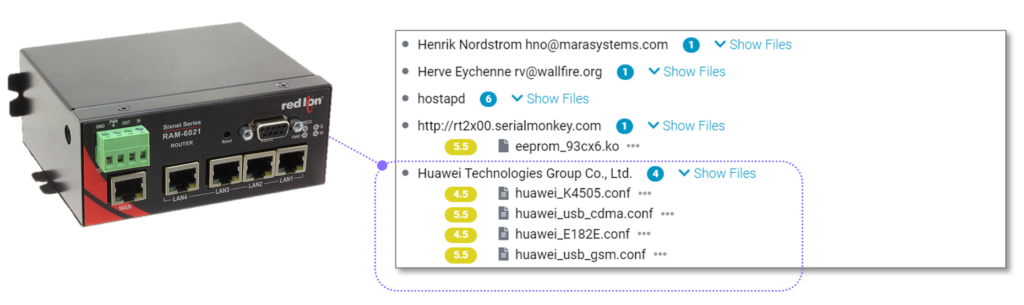
Undeclared Huawei modem drivers

Exiger technology identified this corporate entity provenance from the firmware alone. In other words, there was no need to crack open the device.  (Subsequent physical inspection of the device did confirm presence of Huawei technology.)

Impact

Were there any hidden risks in this device? Yes. But the issue was not that the drivers were bad. The problem is that a sanctioned or precluded Huawei modem in the box was not declared.  

Huawei is on the U.S. Bureau of Industry and Security Entity List, prohibiting the sale of new communications equipment and its use in U.S. telecommunication networks. In 2022, the FCC stopped authorizing new Huawei telecom gear for import or sale, while running a “rip-and-replace” reimbursement program to remove existing equipment from smaller carriers’ networks. 

This non-destructive hardware analysis via firmware attribution would enable purchasers of this device (and other devices bearing sanctioned or forbidden technology) to detect the problematic components at a distance, quickly and inexpensively. For organizations pursuing rip-and-replace strategies to meet SCRM mandates, the Exiger solution offers a scalable alternative to physically inspecting a large inventory of devices. 

Exiger’s binary analysis enables software supply chain security and cyber supply chain risk management by exposing hidden cyber risks across a wide variety of technology and ensuring regulatory compliance. 
‍

Analysis of binaries to find drivers for undeclared and disallowed hardware.
Capability extends beyond modems to other critical OT devices.
Image Description
Scalable alternative to rip-and-replace strategies to meet regulatory requirements.

‍

DEMO THE EXIGER PLATFORM
insights

Perspectives

Article

The Connective Tissue: How Kyndryl Wired Procurement, Risk, and AI Into One Buying Experience

AI technology
Autonomous Supply Chain
Risk & Operations
Supply Chain Resilience
Third Party Risk Management
Webinar

From Critical Signals to Action: Connecting Procurement, Risk and AI

AI technology
Risk & Operations
Supply Chain Management
Supply Chain Risk Management
Supply Chain Visibility
Webinar

The Four Forces Shaping Resilience in 2027

Supply Chain Management
Supply Chain Risk Management
Supply Chain Visibility
Risk & Operations
Tariffs and Trade Friction
Your Backup Supplier May Share the Same Point of Failure
Article

Your Backup Supplier May Share the Same Point of Failure

AI technology
Autonomous Supply Chain
Compliance
Risk & Operations
Supply Chain Resilience
Faster Sourcing Changes the Risk Equation
Article

Faster Sourcing Changes the Risk Equation

AI technology
Autonomous Supply Chain
Compliance
Risk & Operations
Supply Chain Resilience
Why Procurement Is Moving Up the CFO Agenda
Article

Why Procurement Is Moving Up the CFO Agenda

AI technology
Autonomous Supply Chain
Compliance
Risk & Operations
Supply Chain Resilience
DPW 2026 and the Decisions Procurement Can Change
Article

DPW 2026 and the Decisions Procurement Can Change

AI technology
Autonomous Supply Chain
Compliance
Risk & Operations
Supply Chain Resilience
The Agentic Procurement Reality Check
Article

The Agentic Procurement Reality Check

AI technology
Autonomous Supply Chain
Compliance
Risk & Operations
Supply Chain Resilience
FCC Moves to Require Onshoring or Reciprocal Recognition of Device Test Labs
Client Alert

FCC Moves to Require Onshoring or Reciprocal Recognition of Device Test Labs

AI technology
Compliance
Foreign Ownership
Geopolitical Issues
Supply Chain Optimization
Executive Order 14415 Could Reach Commercial and Dual-Use Suppliers
Article

Executive Order 14415 Could Reach Commercial and Dual-Use Suppliers

Critical Infrastructure
Defense
Geopolitical Issues
Part Selection and Management
Supply Chain Management
Executive Order 14415 Puts Product-Level Evidence at the Center of Defense Supply Chain Risk
Article

Executive Order 14415 Puts Product-Level Evidence at the Center of Defense Supply Chain Risk

Defense
Critical Minerals
Supply Chain Visibility
Supply Chain Risk Management
Government Regulations
Exiger & Vodafone Executive Dinner
Event

Exiger & Vodafone Executive Dinner

Autonomous Supply Chain
Supply Chain Management
Supply Chain Optimization
Supply Chain Resilience
Supply Chain Risk Management