
For policymakers and trade compliance officials, the most significant change is the expansion of China’s strategic stockpiling framework. The revised law calls for a government-led, whole-of-society system to increase reserves of strategic materials, technologies, and production capacity needed for defense mobilization. It specifically encourages and supports companies, public institutions, and social organizations to increase physical stockpiles, technology reserves, and production capacity.
What To Watch
Understanding the details of the National Defense Mobilization Law can help companies predict where economic security policy is going:
Article 9: Requires local governments to fund the PRC military. There will be increased pressure by Western governments to stop certain sales to companies owned/controlled by these entities.
Article 46: The PRC Ministry of Defense will conduct “supply chain security” assessments across the defense industrial base.
Article 40: The PRC will expand its strategic “materials and technology” stockpiles for goods that it cannot produce. PRC companies, “public institutions and social organizations” are now required to acquire these materials.
Article 48: “The state shall give appropriate play to market mechanisms and encourage and support organizations and individuals in participating in the maintenance of capabilities for military-product research and development, production, and maintenance support.”
Incentives to Acquire Foreign Materials and Technologies
Chinese commercial companies, universities, research institutions, and other ostensibly civilian organizations will face increased incentives or obligations to acquire foreign materials and technologies that ultimately contribute to defense-related stockpiles or military production. The law also reinforces the broader integration of civilian industrial capacity into China’s defense mobilization system, increasing the importance of understanding not only the immediate customer but also the ultimate end user and end use.
Foreign materials & technologies
Ostensibly civilian
Civilian industrial capacity
Integrated into defense mobilization system
PRC defense stockpiles / military
Increased Risk of Diversion and Illegal Transshipment
For U.S. and allied exporters, this law increases the risk of diversion and illegal transshipment of strategic materials, sensitive technologies, and dual-use goods into China. Companies should not assume that risk is limited to highly controlled technology. Items classified as EAR99 are still subject to the Export Administration Regulations and can require a license when restricted end users, end uses, or destinations are involved. The Bureau of Industry and Security (BIS) also maintains specific controls related to Chinese military and military-intelligence end users and end uses.
How Exiger Can Help
The practical implication of the law is that companies should expect greater scrutiny around transactions involving PRC buyers and third-country intermediaries seeking materials, equipment, components, software, and technology that could support strategic stockpiling or military production.
Active Monitoring
Companies should monitor for elevated risks for transactions involving:
- universities and research institutes,
- state- or locally-affiliated enterprises,
- third-country distributors with low end-user visibility,
- unusual third-country routing,
- sudden shifts in purchasing volume or product mix.
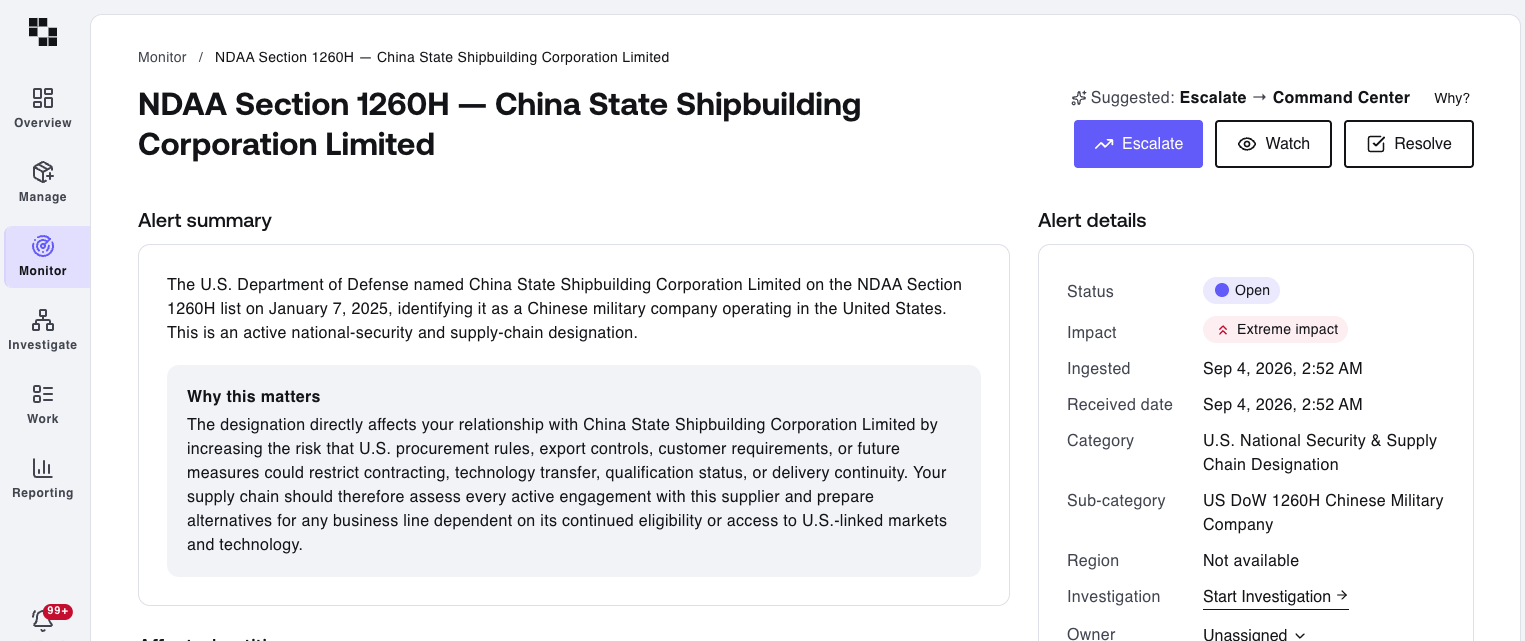
SOURCE: 1EXIGER.AI
End User Validation
Companies should review internal policies for China-related export and reexport controls with this broader mobilization framework in mind.
Compliance programs should validate ultimate end users and beneficial ownership, assess potential military or strategic-stockpile end uses, monitor third-country transshipment routes, and investigate transactions where the stated commercial use does not align with the buyer’s profile or purchasing behavior.
Get an Exposure Assessment
Organizations with China-related export exposure can use 1EXIGER.AI to validate end users, assess beneficial ownership and monitor diversion risks through third countries.
Contact us or reach out to your Customer Success Manager to get started.
Table of Contents
Get in Touch
Learn how you can build a more resilient supply chain.


