
On March 28, 2026, Iranian missile and drone attacks struck two of the world’s largest aluminum production facilities: Emirates Global Aluminium’s (EGA) Al Taweelah smelter in Abu Dhabi and Aluminium Bahrain’s (Alba) smelter in Bahrain.
Iran’s Revolutionary Guard Corps said it had targeted Alba and EGA in response to attacks on two Iranian steel plants, citing ties to U.S. military and aeronautics firms. Both firms are major suppliers to the global aerospace sector. EGA confirmed “significant damage” and injuries to six employees. Alba reported two employees injured and is assessing facility damage. Aluminum surged 6% to $3,492/t on the LME in early Monday trading.
Exiger assesses this as a critical escalation: the supply risk has shifted from blocked exports to damaged production capacity. Since the conflict began in early March, Gulf producers had been managing through logistics workarounds: EGA was rerouting exports through Oman’s Port of Sohar by truck; Alba had executed a controlled shutdown of 19% of capacity and declared force majeure; Qatalum shut down due to gas shortages – those were supply and logistics constraints; physical smelter damage is fundamentally different. Previously, Exiger had classified these as logistics based issues, where as now the physical damage to a smelter is fundamentally different with longer recovery implications. The disruption is also cascading beyond aluminum: Bahrain’s Foulath Holding, parent of Bahrain Steel, declared force majeure on its operations the same day.
Facility Profiles
Emirates Global Aluminium (EGA)
Al Taweelah smelter, Abu Dhabi. Produced 1.6 million tonnes of cast metal in 2025; sold 2.84 million tonnes total. The world’s largest ‘premium aluminum’ producer with 400+ customers in 50+ countries. Output includes premium alloys used by Boeing and Airbus. EGA’s adjacent Al Taweelah alumina refinery produced 2.4 million tonnes of alumina in 2025. EGA also operates a smelter in Jebel Ali (Dubai), which is continuing operations with limited resources. EGA is equally owned by Mubadala Investment Company and the Investment Corporation of Dubai.
Aluminium Bahrain (Alba)
World’s largest single-site smelter. Annual production capacity exceeding 1.62 million tonnes. Declared force majeure on March 4 after Hormuz closure prevented shipments and disrupted inbound alumina supplies. Had already shut down Lines 1, 2, and 3 (19% of capacity) in a controlled shutdown on March 15. State-controlled.
Key Industry Impacts
The Gulf region accounts for approximately 9% of global primary aluminum production, with nearly 80% of regional output exported, primarily to the United States and Europe. The US secured 21% of its imported primary aluminum from the UAE and Bahrain alone, hauling 584,000 tonnes in the first eleven months of 2025. The UAE was the third-largest aluminum supplier to the US after Canada and South Africa.
Shipment volumes surged in 2025. This reflects a broader shift in Western aluminum sourcing: after the US and UK banned Russian aluminum from major exchanges in April 2024, Russian exports to Western markets fell 45% while UAE and Bahrain exports increased 26% and 15% respectively as buyers pivoted to Gulf sources. The sharp decline beginning in late 2025 and accelerating into early 2026 tracks with the onset of Hormuz disruptions and the conflict’s impact on Gulf export capacity.
The 12-month view shows monthly shipment volumes averaging 2,500-3,900 through 2025. February 2026 data shows a significant decline, with the full impact of the conflict expected to appear in March data as reporting lags resolve.
(Source: Exiger) GLOBAL SHIPMENT VOLUME FROM ALBA AND EGA OVER THE LAST 12 MONTHS
EGA and Alba’s direct shipment recipients are predominantly trading intermediaries, metals warehousing operators (C. Steinweg, Access World), commodity finance institutions, and the companies’ own US-based subsidiaries (Aluminium Bahrain US Inc and EGA America Inc, which together received over 17,000 shipments). This reflects how primary aluminum moves through multiple layers of the supply chain before reaching end-use manufacturers. This is precisely why this disruption is difficult to detect without sub-tier visibility: the companies most exposed to Gulf aluminum dependency may not have any direct commercial relationship with EGA or Alba.
Exiger’s analysis of customers by industry confirms this pattern. While direct recipients cluster in aluminum manufacturing, logistics, trading, and metals warehousing, the downstream industries ultimately consuming this metal, automotive, construction, aerospace, electronics, oil and gas, steel manufacturing, are exposed through their own suppliers’ dependence on Gulf-origin feedstock.
(Source: Exiger) TOP 10 UNIQUE CUSTOMERS BY INDUSTRY
From Blocked Exports to Damaged Capacity
Before March 28, the logistics workarounds were holding. Industry analysts estimated that 70-80% of regional production could be rerouted through alternative ports at higher cost. Saturday’s strikes changed that calculus entirely.
Physical damage to smelter infrastructure is fundamentally different. Aluminum smelting is a continuous process: electrolytic cells (potlines) operate at extremely high temperatures around the clock. Bloomberg reported on April 1 that EGA’s Al Taweelah smelter lost power due to the strikes, forcing potlines into an uncontrolled shutdown. Metal has solidified inside the smelting circuits, causing significant damage to operations. Restarting frozen potlines requires physically removing the solidified metal and reconstructing the cells, a process that can take six to twelve months. EGA has begun offering to sell alumina cargoes for April through June delivery, confirming the smelter cannot consume its own feedstock.
While EGA has not issued a formal production timeline, the company noted it had “substantial metal stock on the water when the conflict began, and stock on the ground in some overseas locations”, which may cushion near-term supply disruptions. However, any prolonged outage at a facility producing 1.6 million tonnes annually would significantly tighten a market already under acute stress.
Where the Downstream Impact Hits
EGA and Alba are primarily commodity-grade primary aluminum producers. They produce high-purity ingot (P1020), sow, and extrusion billet, essentially the raw feedstock that goes to downstream converters. They are not producers of finished semi-fabricated products. The downstream impact is therefore at the mill products level: rolling mills and extruders that convert primary metal into sheet, plate, extrusions, and forgings for end-use industries.
Organizations with a higher percentage dependence on EGA and Alba primary metal as feedstock, relative to alternative sources, face the greatest exposure. The impacted downstream sectors include:
- Automotive manufacturing. EGA’s aluminum is used by major OEMs globally, including as feedstock for body-in-white sheet, structural extrusions, and engine/transmission castings. EGA specifically serves the construction, automotive, packaging, aerospace, and electronics industries. Rising primary metal costs and allocation pressure will flow through to Tier 1 suppliers and assemblers.
- Construction and infrastructure. Aluminum extrusions for curtain wall systems, structural framing, and cladding depend on billet supply. The Gulf is a major extrusion billet supplier to Europe and Asia.
- Packaging. Can sheet (beverage cans) and foil stock depend on rolling slab from primary producers. Tighter slab availability will push spot premiums higher.
- Aerospace. Both EGA and Alba are major suppliers to the global aerospace sector. EGA produces premium alloys used by Boeing and Airbus. Aerospace-grade primary metal requires tight chemical specifications; alternative sources must meet qualification requirements.
- Electronics. High-purity aluminum is used in semiconductor packaging, heat sinks, and consumer electronics casings.
- Energy and utilities. Aluminum is a critical input for power transmission conductors, solar panel frames, LNG heat exchangers, wind turbine components, and battery enclosures. Tighter supply and rising premiums will flow through to procurement costs for generation, transmission, and renewable energy infrastructure.
- Steel and metals processing. Bahrain’s Foulath Holding, parent of Bahrain Steel, declared force majeure on March 28 due to conflict-related disruption, adding pressure to global metals supply chains already strained by sanctions and trade restrictions
Broader Context: US Aluminum Supply Dependency
Approximately 85% of the aluminum needs of American industries are currently met by imports. In January 2026, EGA and Century Aluminum announced a joint venture (EGA 60% / Century 40%) to build a $4 billion, 750,000 tonne/year smelter in Inola, Oklahoma, the first new US aluminum smelter in nearly 50 years. The plant would use EGA’s proprietary EX smelting technology and was expected to more than double current US production. Construction was targeted to begin by end of 2026, with production by end of the decade. With EGA’s home operations now materially impaired, the timeline and viability of this project, central to the US strategy of reducing aluminum import dependence, faces increased uncertainty.
Producer | Status | Details |
Emirates Global Aluminum UAE | Halted | |
Emirates Global Aluminum | Operating | Continuing operations with limited resources for 10-12 days. Senior management reviewing situation. |
Aluminium Bahrain (Alba) Bahrain | Damaged/Partial Shutdown | |
Qatalum Qatar | Shutdown | Controlled production shutdown since March 3 due to natural gas shortages. |
Sohar Aluminum | Operating | Facility at Sohar port operational. Serves as primary logistics hub for rerouted Gulf exports. |
Ma’aden Aluminum | Monitoring | No reported damage. Minor aluminum exporter to US (18,000 tonnes in 2024). |
Foulath Holding / Bahrain Steel | Force Majeure |
Anticipated Disruptions
Production Capacity Loss
EGA Al Taweelah and Alba together represent over 3.2 million tonnes of annual capacity. With Al Taweelah damaged, Alba in partial shutdown, and Qatalum offline, close to 8-9% of regional supply is at risk. Any prolonged outage will tighten an already constrained global market.
Feedstock Allocation Pressure
Downstream rolling mills and extruders that depend on Gulf-origin primary metal will face tighter allocation. Mills may prioritize long-term contracted customers over spot buyers, creating uneven exposure across the supply chain
Price Escalation
Aluminum prices have risen 12% since the conflict began. The US Midwest premium hit a record $1.10/lb. Further escalation is expected as physical supply tightness becomes apparent in downstream order books over the coming weeks.
Logistics Rerouting Costs
Even for undamaged production, the Hormuz closure forces overland trucking to Sohar at significantly higher cost than direct seaborne shipping, creating bottleneck risk at alternative ports. Lead times for alumina imports will extend.
What Organizations Should Do Now
- Map aluminum supply exposure.
Identify direct and indirect consumption of EGA- and Alba-sourced primary aluminum across your supply chain. Determine sourcing concentration by supplier, facility, and product type. Organizations receiving rolled, extruded, or cast products from downstream mills should trace feedstock provenance to assess indirect Gulf dependency. - Assess contract and allocation risk.
Review supply agreements with primary metal suppliers and downstream converters for force majeure provisions, allocation triggers, and price adjustment clauses. Organizations on spot or short-term contracts face the highest near-term exposure. Alba has already declared force majeure; EGA may follow depending on damage extent. - Evaluate alternative sourcing.
Engage alternative primary aluminum suppliers including Canadian producers (the US’s largest source at 3.15 million tonnes in 2024), South African producers, and domestic smelters. Note that all imports are subject to Section 232 tariffs (currently 50%), and global supply is already tight. - Monitor restoration and conflict developments.
Track updates from EGA and Alba on damage assessments, production ramp-up timelines, and Hormuz reopening developments. Watch for formal force majeure declarations from EGA, secondary supplier capacity constraints, and downstream mill allocation announcements. - Stress-test continuity scenarios.
Model 30-, 60-, and 90-day disruption scenarios against production schedules, customer delivery commitments, and inventory levels. Factor in both the physical damage scenario (months-long capacity loss) and the logistics scenario (continued Hormuz closure even if smelters are repaired).
The strikes on EGA and Alba are part of a broader pattern of retaliatory actions targeting material supply chains across the UAE, Bahrain, and Israel in response to ongoing IDF strikes on Iranian industrial infrastructure. Exiger will continue to monitor the situation and provide updates as developments unfold.
How Exiger Can Help
The 1Exiger platform helps you understand, respond to, and prevent disruptions.
Supply Chain Exposure Mapping
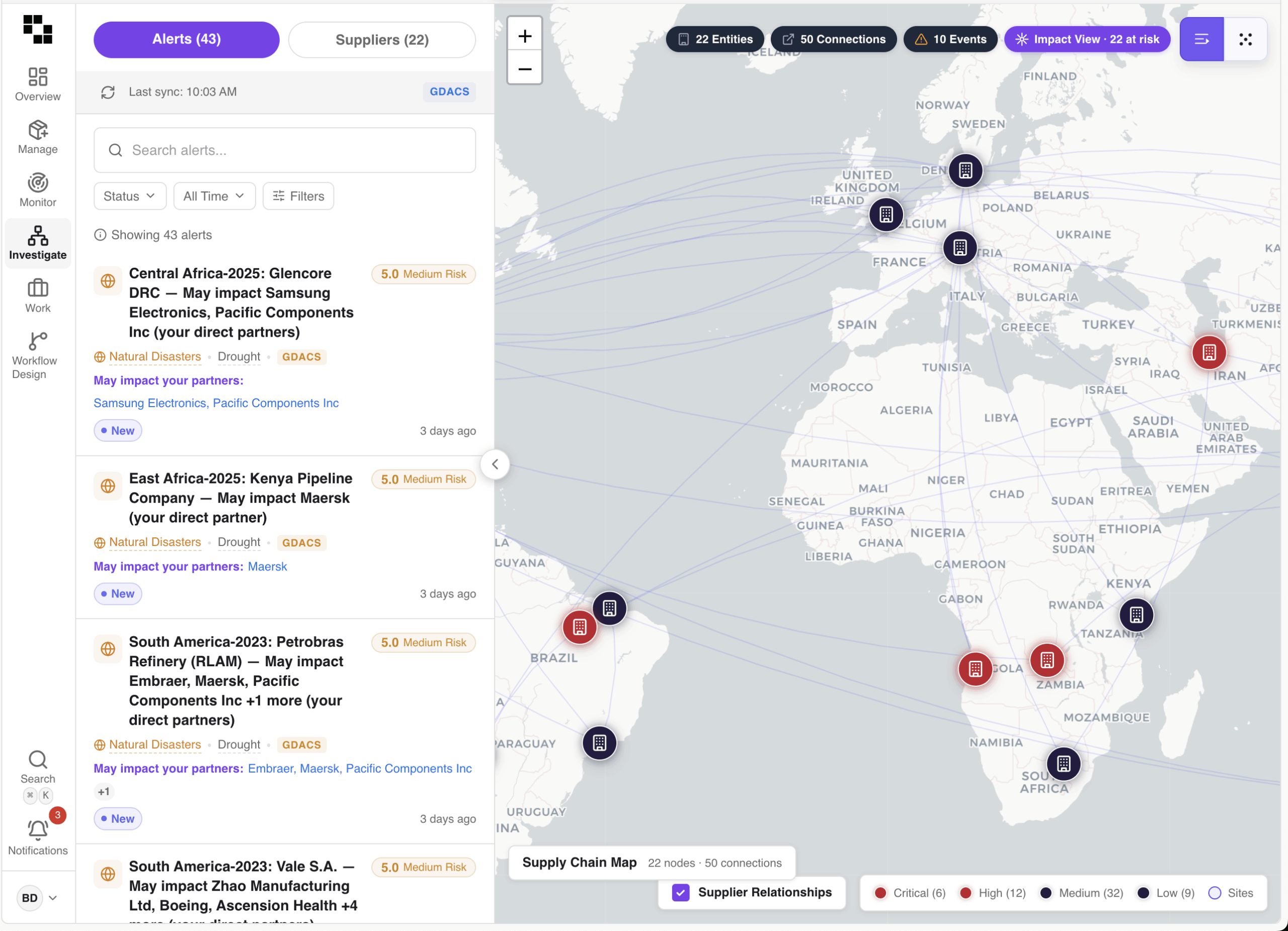
Uses our AI and ontology to connect relationships across suppliers, sites, materials, and upstream dependencies; helping teams understand if and how their networks are exposed.
Screenshot: a detailed view of your global network and how disruption events may impact flow. (Source: Exiger)
Dependency and Concentration Analysis
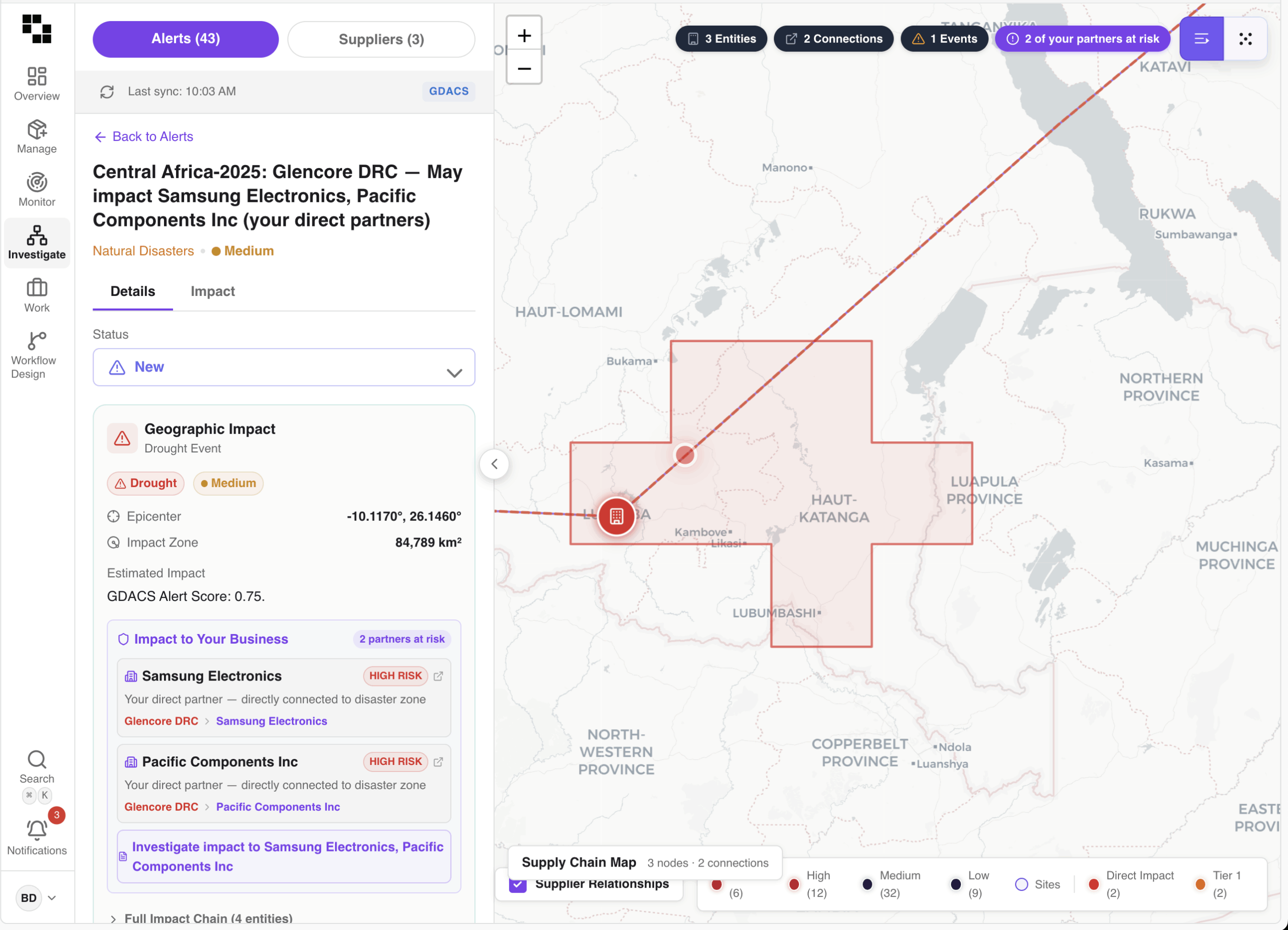
Identifies where direct and indirect reliance on suppliers like EGA and Alba impact your value chains.
Screenshot: 1Exiger identifies critical chokepoints, even in the sub-tiers, that may be impacted by disruption events. (Source: Exiger)
Alternative Sourcing Analysis
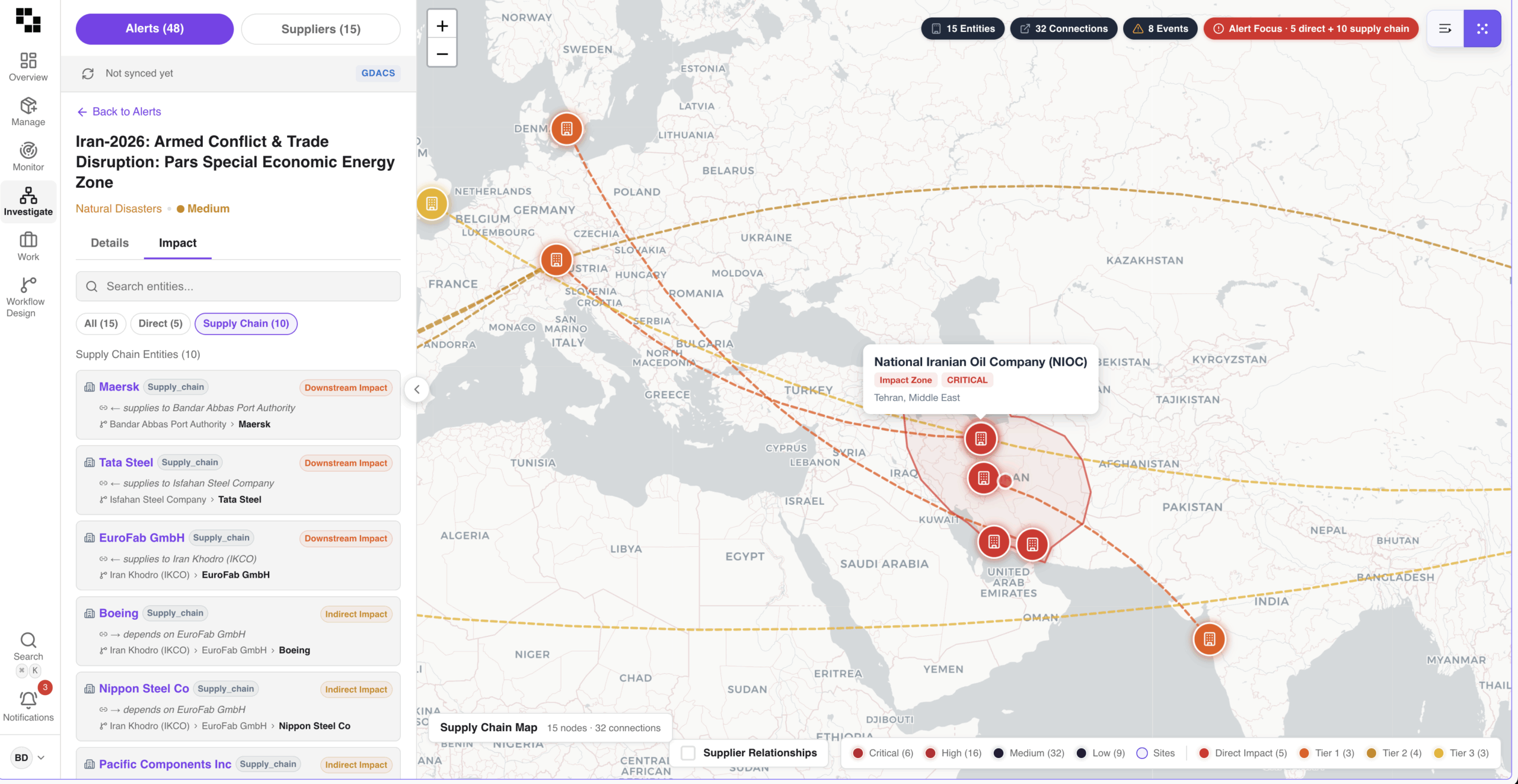
Identifies and onboards substitute sources considering manufacturing capability, geographic fit, and more.
Screenshot: see projected downstream impact from disruption events at every tier. (Source: Exiger)
Scenario Modeling and Sensitivity Testing
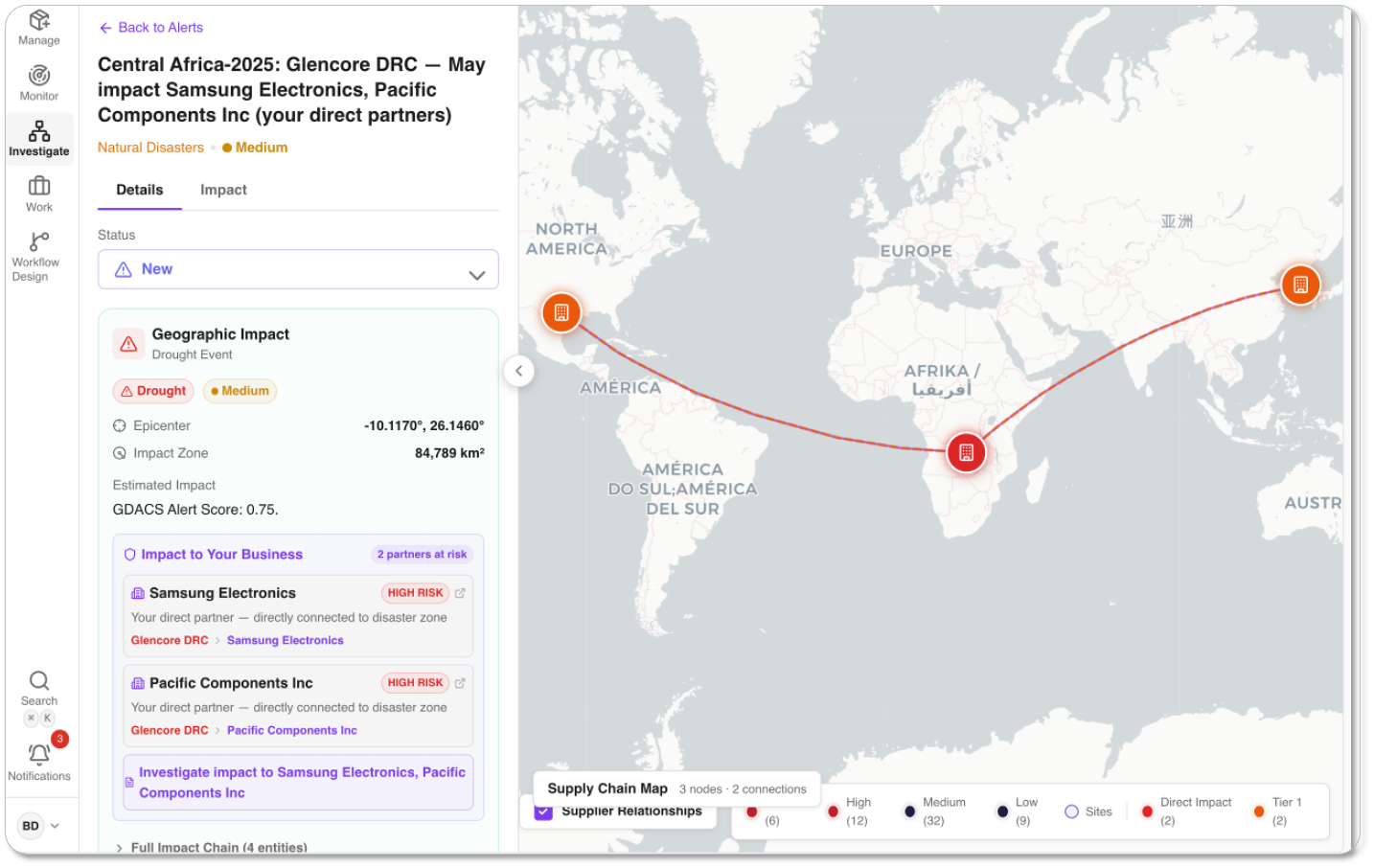
Models disruption scenarios to quantify downstream impact, stress-test resilience, and compare mitigation strategies across suppliers, parts, and materials.
Screenshot: model impact for various conditions and receive recommended courses of action
(Source: Exiger)
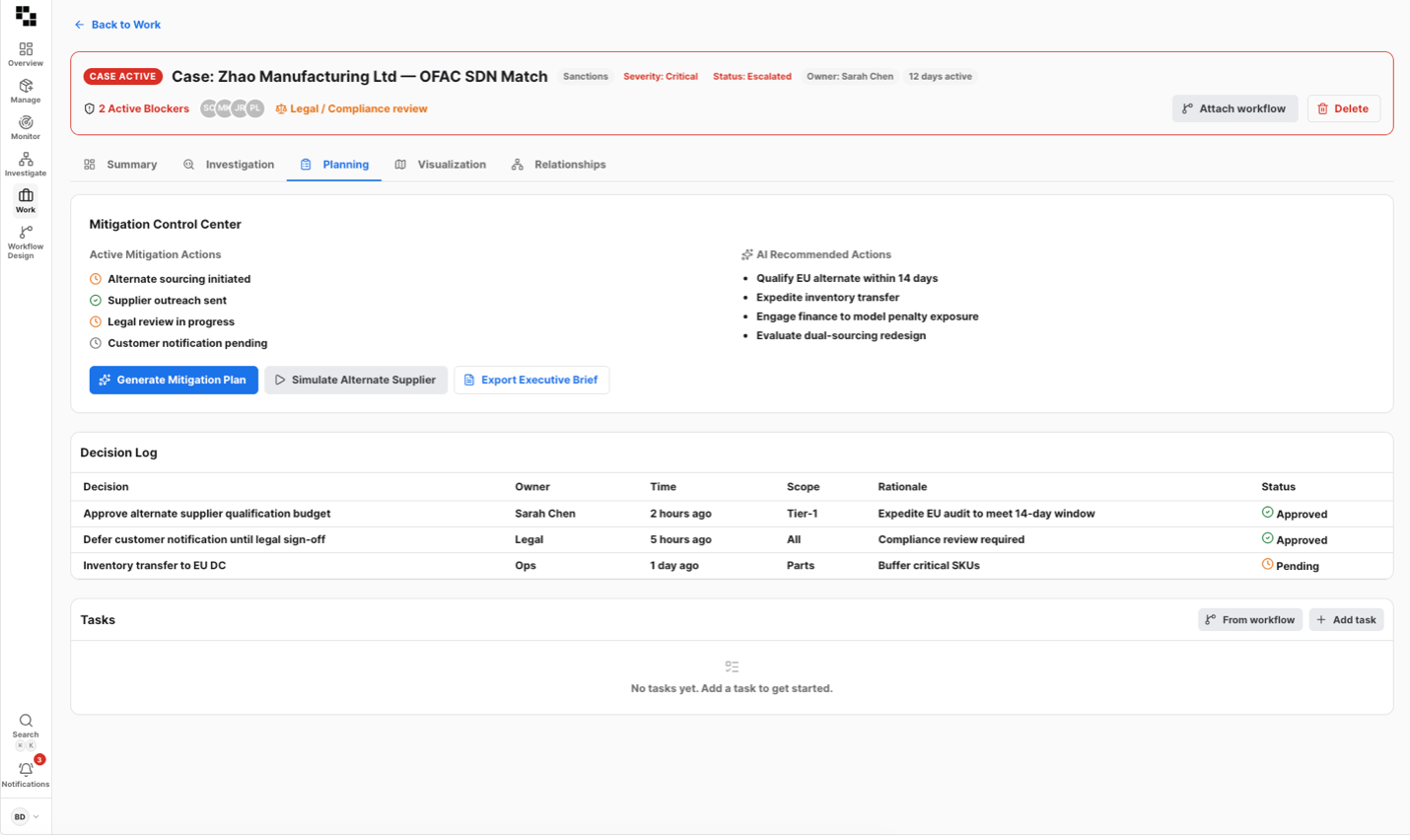
Unified Risk Governance and Response Workflows
Brings monitoring, escalation, ownership, and mitigation together into one coordinated response.
Screenshot: custom workflows and agentic AI connect cross functional teams and execute remediations to prevent disruption. (Source: Exiger)
Get in Touch
Get an Exposure Assessment
Organizations exposed to Gulf-linked trade, energy inputs, or Red Sea corridors should initiate an immediate exposure assessment with Exiger.
Contact us or reach out to your Customer Success Manager to get started.
Table of Contents
Get in Touch
Learn how you can build a more resilient supply chain.


