
Supply chain disruption is increasingly becoming a decision-speed problem.
The Shift from Supply Chain Visibility to Action
Prove position, prioritise review, act without freezing the business.
Reduce the delay between signal and coordinated response.
Sharpen trade-offs across cost, continuity and exposure.
The shift happening inside supply chain organisations is no longer about visibility alone. Most enterprises already have supplier records, procurement systems, engineering data and compliance documentation spread across the business. The operational challenge is determining which disruptions materially affect production, sourcing, customer commitments or compliance obligations quickly enough to respond.
That operational gap was a central theme during Exiger’s Gartner Supply Chain Symposium | Xpo Barcelona session, Supply Chain Command in Practice: Driving Growth, Profit, and AI Enablement. Several themes emerged consistently throughout the discussion:
- Organisations are overwhelmed by disconnected supplier intelligence. ERP systems, supplier questionnaires, engineering records and compliance data often exist in isolation, making it difficult to evaluate business impact during disruption events.
- Alert fatigue is becoming a supply chain operational problem. Teams receive large volumes of disruption notifications without clear prioritisation tied to sourcing, production or revenue exposure, increasing the likelihood that material risks are overlooked.
- Periodic supplier assessments are no longer sufficient. Sanctions updates, forced labour enforcement actions and geopolitical disruptions are moving faster than quarterly or annual review models can support.
- AI systems become more useful when embedded directly into workflows. The discussion distinguished between general-purpose prompting tools and operational AI integrated into supplier onboarding, disruption management and sourcing decisions.
- Leading organisations are connecting risk monitoring to operational response. Customer examples demonstrated how multi-tier mapping and continuously validated supplier intelligence are helping teams identify alternative suppliers, reduce sourcing exposure and accelerate procurement decisions.
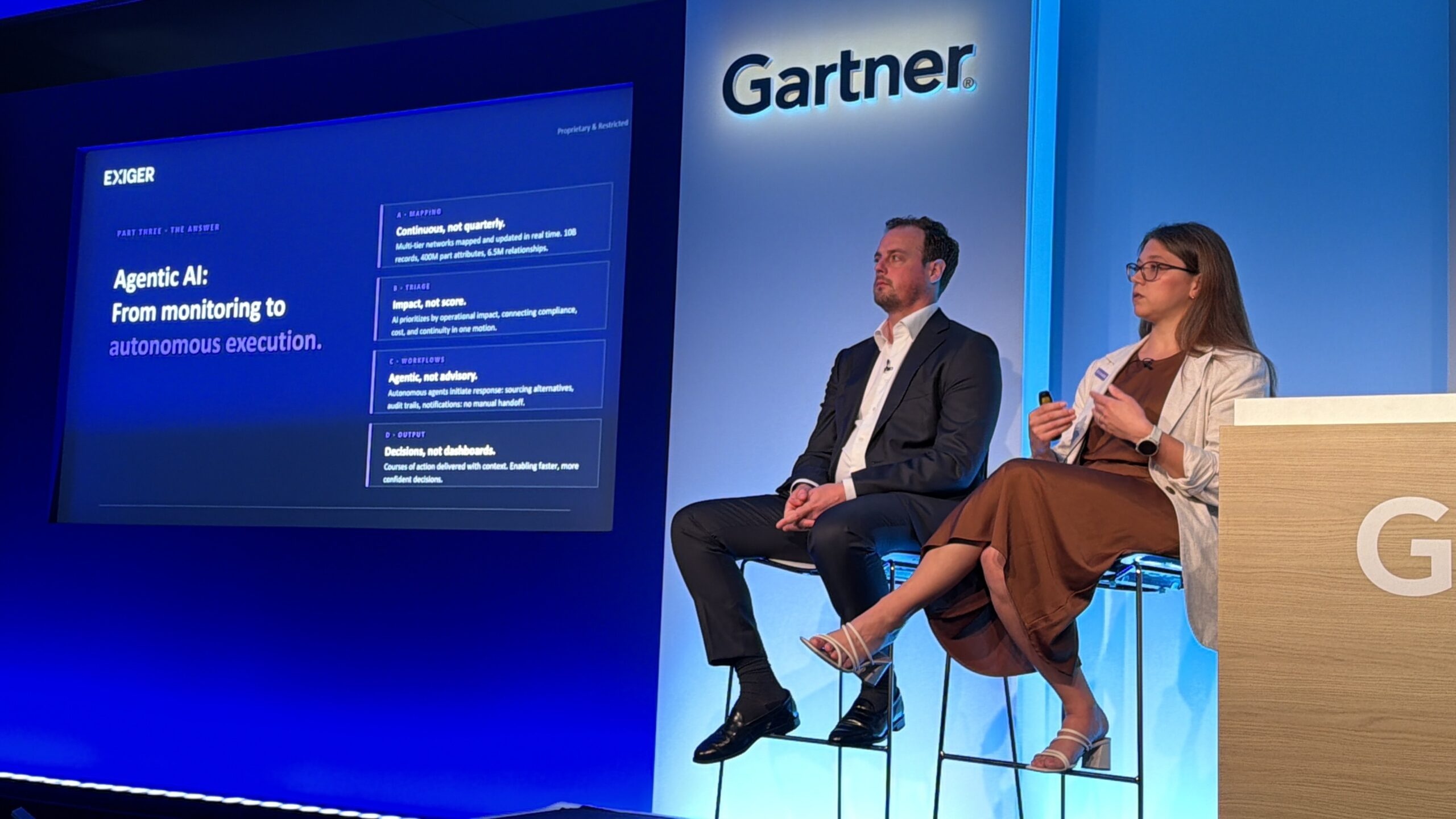
The timing is relevant. In the session, Kaitlyn Huissen noted that Exiger has been named a Leader in the Gartner Magic Quadrant for Supplier Risk Management for the second year running, positioned highest in execution and furthest in vision. For CSCOs, the useful question is not simply which vendor can show the most risk signals. It is which operating layer can help the organisation decide what to do next.
1ExigerAI is the platform expression of Supply Chain Command. It brings supplier, part, product, regulatory and workflow context into the same decision path so an alert can be assessed against business impact, prioritised by criticality and viability, and routed into the right action path.
Compliance: Know Where Exposure Becomes Material
Compliance is often the first place disconnected data becomes visible.
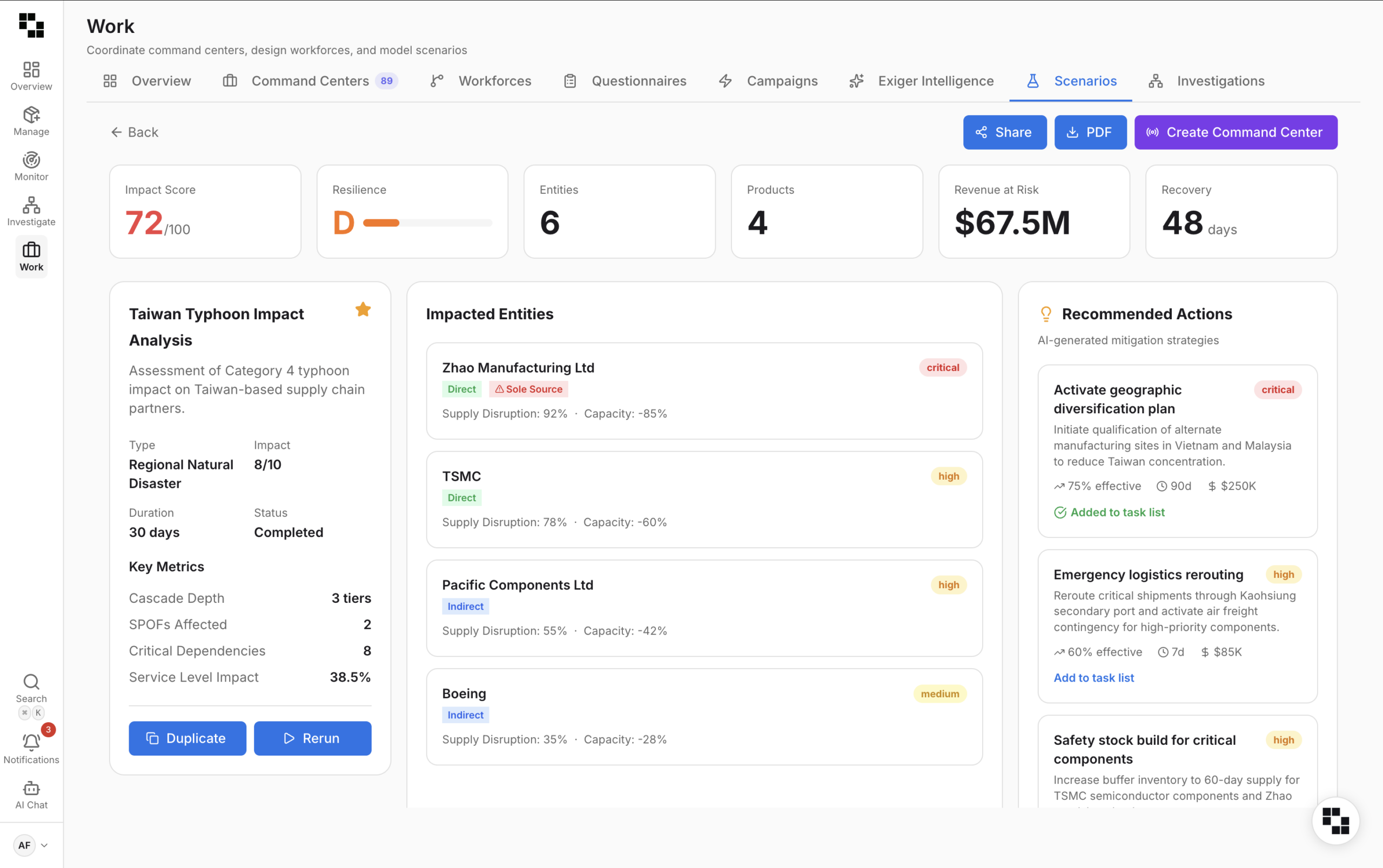
A new regulation lands. A forced labour signal emerges in a sub-tier relationship. A sanctions concern appears through an ownership structure. A tariff change alters landed cost across a material category. The executive question is immediate: are we exposed?
Traditional compliance response is often linear. Find the data. Compare supplier declarations. Search product lists. Contact suppliers. Review contracts. Build the spreadsheet. Escalate the exceptions.
Every step may be necessary. The problem is the sequence. Too much of the work begins only after the question is asked.
The forced labour example from the session makes this concrete. An anonymised company had made a public commitment to remove forced labour from its supply chain, but investigative testing identified restricted-region cotton in its supply chain. The organisation had been relying on a more reactive model: onsite social audits, supplier-by-supplier reviews and what Mark Henderson described as a “whack-a-mole” approach. Those tools can be valuable, but they do not scale when the risk sits deeper in the supply chain.
Supply Chain Command starts earlier. It connects the supplier record to the item, the item to the product, the product to the programme and the programme to the business consequence. That does not replace legal, trade or procurement judgement. It gives those teams a stronger starting point.
For CSCOs, the goal is not simply to avoid penalties. It is to prove position, prioritise review, and act without freezing the business. A theoretical exposure should not consume the same attention as a material exposure tied to a critical product or customer commitment.
That is a better test of compliance readiness: not whether the organisation has a file, but whether it can answer quickly, defend the answer and start the right work.
Disruption: Every Alert Needs Business Context
The second reality is disruption.
Supply chain teams are not ignoring risk because they are inattentive. They are often receiving too many signals with too little business context. A weather event, financial deterioration, cyber notice, port closure or supplier incident may all appear urgent. But urgent to whom? For which product? Against what revenue? With what available mitigation?
This is where alert volume becomes operational drag.
Criticality looks at what is at stake: revenue, customer commitments, mission impact, production continuity, compliance exposure or contractual obligations.
Those questions help teams separate an interesting signal from a material event. The useful first question after an alert is not, “Who has the latest spreadsheet?” It is, “What work needs to begin?”
That work may include contacting the supplier with the right context, identifying affected products, assessing alternate sources, preparing a qualification business case or escalating to the customer team. The point is not to make disruption disappear. It is to reduce the delay between signal and coordinated response.
Optimisation: Risk Insight Should Improve Commercial Decisions
Supplier risk management is often discussed as a defensive discipline. That is too narrow. The same connected view of suppliers, parts, products and constraints can help the business make better commercial decisions.
CSCOs are being asked to reduce cost, protect margin, support growth, improve supplier performance and meet compliance obligations without slowing the organisation down. Those goals can conflict when decisions are made with partial context.
A sourcing team may identify a lower-cost supplier without seeing sub-tier exposure. A continuity team may add redundancy where the real constraint sits somewhere else. A compliance team may request broad review across a category when only a narrow set of parts drives material exposure.
Supply Chain Command helps sharpen those trade-offs.
If a supplier is high risk but tied to a non-critical, easily replaceable item, the response may be commercial. If a supplier is moderate risk but tied to a critical, low-viability component, the response may require executive attention. If a category looks expensive but carries hidden qualification constraints, the optimisation opportunity may sit in engineering, not sourcing.
That is why this conversation belongs with growth and profit, not only resilience. Better supplier risk operations can support cost-out strategy, supplier rationalisation, alternate sourcing, compliance review and continuity planning from the same connected view of the supply ecosystem.
Optimisation is not only about finding savings. It is about making decisions that do not create tomorrow’s exposure while solving today’s margin problem.
The Old Model Breaks Under Pressure
Most large organisations are not short of supplier data. They have ERP records, PLM data, transportation feeds, supplier questionnaires, attestations, contracts, spreadsheets and years of reporting.
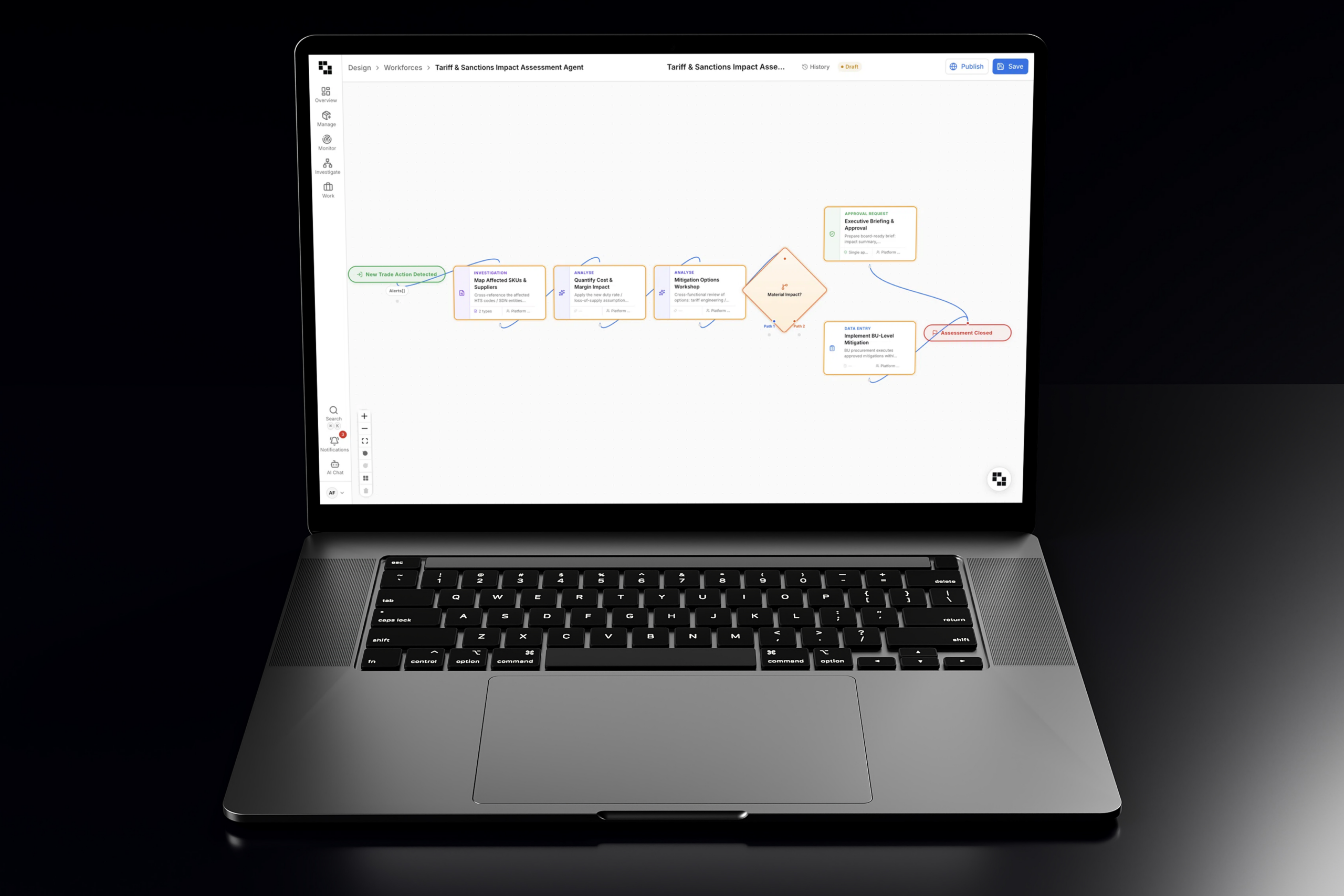
Take a tariff change affecting aluminium or steel. A company may already have country-of-origin information, HTS codes, supplier attestations, contract volumes and product data. Yet if those inputs sit across disconnected systems, the team may still spend days answering basic questions: which products are exposed, how material is the impact, which suppliers matter most and what options exist?
Supply Chain Command treats supplier intelligence as operational infrastructure. The objective is not simply expanding supplier visibility. The objective is improving how organisations prioritise disruptions, evaluate dependencies and make sourcing and compliance decisions under pressure.
That operational shift was reinforced throughout Exiger’s Gartner Symposium Barcelona session, where customer examples demonstrated how organisations are moving away from reactive assessments and towards continuously monitored, decision-oriented supply chain operations.
Rather than evaluating supplier disruptions as isolated events, organisations are increasingly assessing how exposure cascades across tier-two and tier-three suppliers, production schedules, sourcing dependencies and customer commitments. The discussion repeatedly emphasised that supplier intelligence becomes significantly more useful when connected directly to operational workflows rather than separated into standalone compliance or monitoring exercises.
One of the clearest themes from the session was the growing operational burden created by alert fatigue. Supply chain teams are receiving large volumes of disruption notifications without sufficient context around business relevance, affected products or alternative sourcing paths. As a result, prioritisation is becoming as important as detection itself.
The session also highlighted the limitations of periodic assessment models. Annual supplier reviews and static supplier evaluations cannot keep pace with sanctions changes, forced labour enforcement actions and rapidly shifting sourcing conditions. Organisations are increasingly adopting continuous monitoring approaches capable of identifying sub-tier exposure earlier and supporting faster operational response.
AI was discussed in similarly practical terms. The focus was less on generalised automation and more on embedding intelligence directly into supplier onboarding, disruption management, sourcing optimisation and procurement workflows. In practice, that means combining continuous mapping, intelligent triage and decision-ready recommendations so supply chain teams can move faster from disruption detection to operational action.
AI Must Be Part of the Workflow
AI is now part of nearly every supply chain technology conversation. The harder question is whether it is changing how work gets done.
Without that context, AI may describe the problem. It will not reliably help the organisation respond.
SIGNAL
IMPACT
OWNER
CONTEXT
ACTION
This is the practical promise of AI enablement in supplier risk management: less manual triage, better prioritisation and more consistent execution.
How 1ExigerAI Makes Supply Chain Command Executable
1ExigerAI is the technology expression of this operating layer. In the session, Kaitlyn Huissen described four capabilities that make Supply Chain Command executable: continuous mapping, intelligent triage, agentic workflows and decision-ready output.
What CSCOs Should Ask Now
For leaders assessing their own maturity, the questions are direct.
Can your team connect supplier, part, product, geography and contract data fast enough to answer an executive question during an event?
Can your operating model distinguish between an alert that is interesting and an alert that is material?
Can compliance, disruption and optimisation teams work from the same view of supplier and product impact?
Can your team identify not only which supplier is exposed, but which tier-two or tier-three relationships, materials, products, programmes, customers and revenue are implicated?
Can workflows begin before the status meeting is scheduled?
If the answer to any of these is no, the issue may not be the risk feed. It may be the absence of an operating layer that connects signal, context and action.
Learn how 1ExigerAI helps organizations gain multi-tier visibility, identify critical supply chain nodes, assess supplier viability, and prioritize action across complex supply networks.
Table of Contents
Get in Touch
Learn how you can build a more resilient supply chain.


