China Announces Export Controls on Five Critical Minerals
On February 4, 2025, China announced it would restrict exports of five critical minerals: tungsten, tellurium, bismuth, indium, and molybdenum. Industries dependent on these metals, including defense, renewable energy, electronics, and manufacturing, may experience supply chain disruptions, including delays, price increases, and supply bottlenecks, due to China’s leading role in their production.
Mineral | Uses | |
|---|---|---|
Tungsten | Artillery shells, armor plating, cutting tools, engine parts, airplane balancing weights. | |
Tellurium | Solar panels, thermoelectric devices, infrared optics, steel alloys, and rechargeable batteries. | |
Bismuth | Medical treatments, lead-free solder, cosmetics, flame retardants, and ammunition. | |
Indium | Phone screens, TV displays, fiber-optic technology, semiconductors, and solar panels. | |
Molybdenum | Missile components, nuclear reactors, steel alloys, lubricants, and high-temperature electronics. |
Background
China’s new export controls require licenses to export 20 tungsten, tellurium, bismuth, indium and molybdenum-related products to “safeguard national security interests.” China is the global leader of the rare earths industry overall, dominating about 69% of the world’s production and 90% of the world’s mining. China is the top producer of all five recently restricted metals.
China's Production of Impacted Minerals
Source: Bloomberg
In recent years, China restricted the exports of several other critical minerals. In July 2023, China announced export restrictions on certain gallium and germanium products, metals essential in chip manufacturing, citing national security concerns. Following the announcement, prices for gallium and germanium surged, with gallium prices increasing by nearly 20% in the United States and Europe.
In August 2024, China announced restrictions on antimony, a metal used in defense technology. From August 2024 to December 2024, antimony shipments from China to the United States dropped 97% while prices rose 200%. In December 2024, China banned the export of gallium, germanium, and antimony to the United States entirely.
The scope of China’s export restrictions on the five minerals also includes a ban on the technology to process and refine the materials for their critical uses. This factor pressures rival economies to develop independent supply chains and creates short-term bottlenecks that could disrupt industries relying on these materials.
Exiger Insights
Although China’s recent restrictions do not single out exports to any particular country, the announcement followed the United States’ recent imposition of a 10% tariff on Chinese imports. It is not clear whether U.S. imports of the impacted minerals will qualify for licenses given China’s national security concerns and the minerals’ heavy use in U.S. defense and technology.
Analysis of Weapons Systems Parts and Materials
Source: Exiger
Leveraging Exiger’s proprietary data catalogue of hundreds of millions of part attributes used by the defense industry and federal government, Exiger identified bismuth as the leading impacted material in weapons systems by part count, followed by tungsten and tellurium. Exiger identified aircraft as the weapons system using the most parts containing the five impacted minerals.
Analysis of Weapons Systems Parts and Materials
Source: Exiger
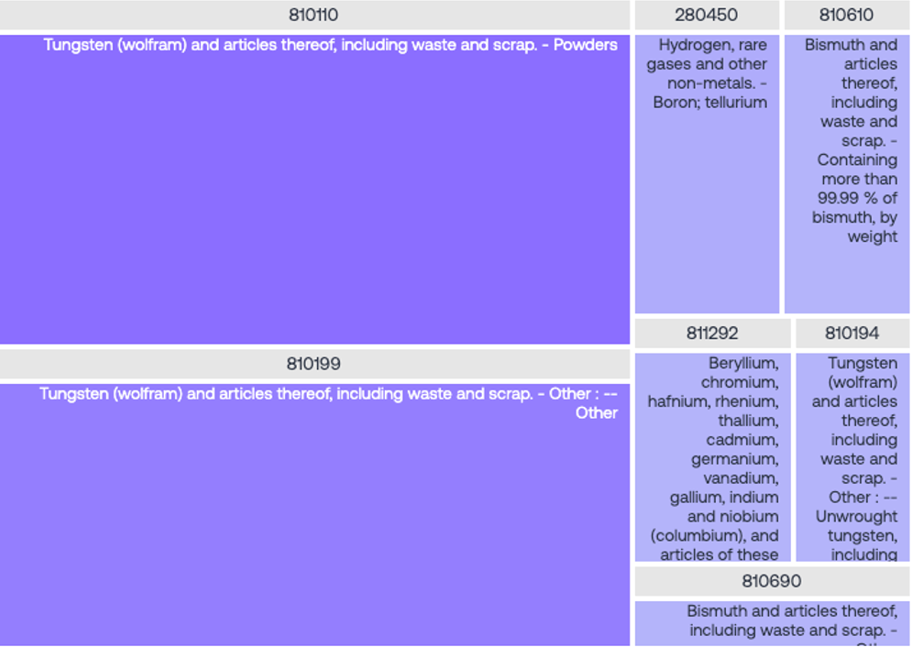
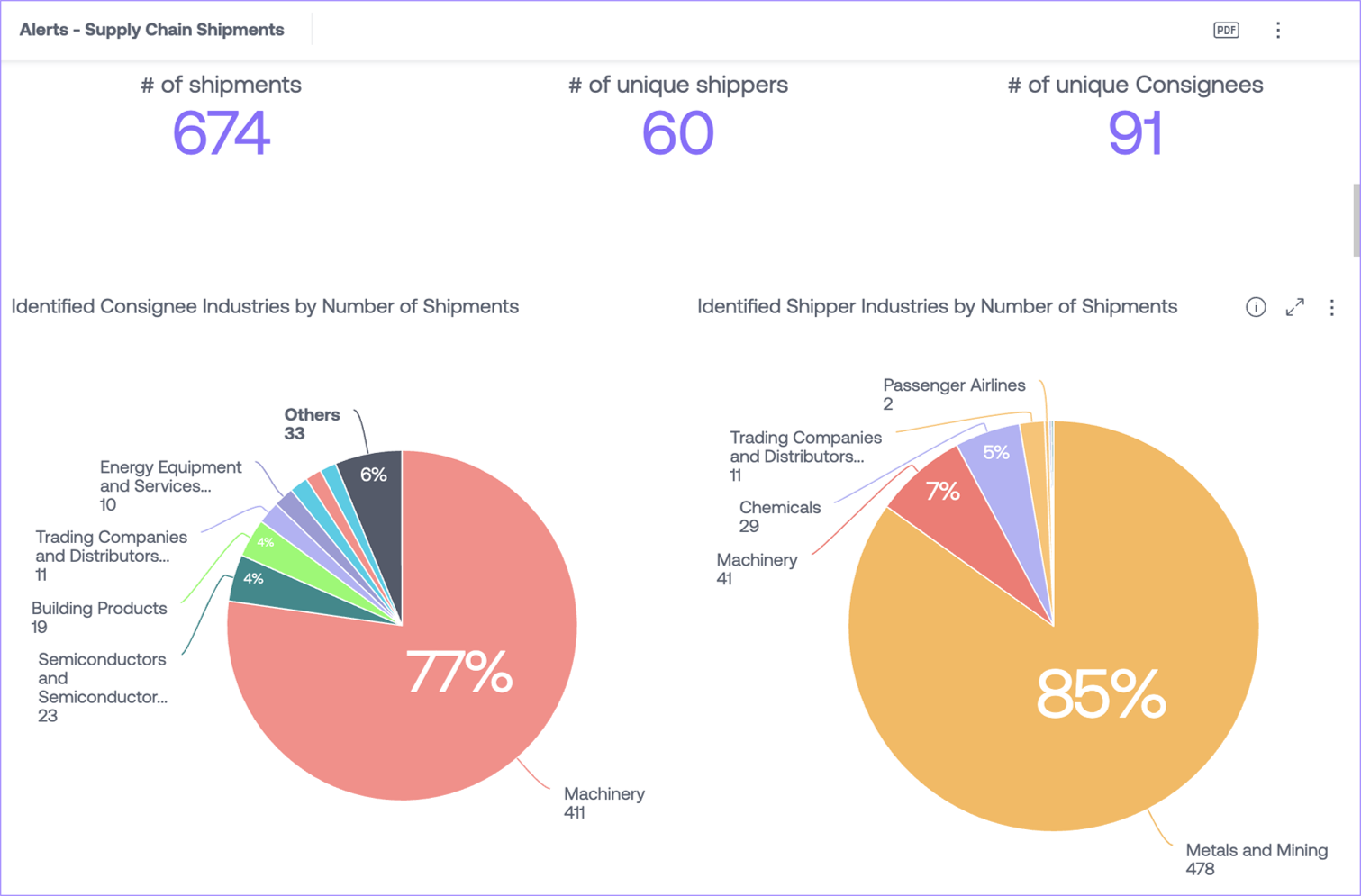
Exiger used its 10 billion supply chain records to develop a dashboard illuminating more than 20,000 shipments of direct purchases of tungsten, tellurium, bismuth, indium, and molybdenum since the start of 2024. Exiger analyzed the HS Codes of the products included in the shipments. HS Codes, or Harmonized System codes, are a standardized system for classifying products used in international trade. Exiger’s analysis indicates that of the five impacted materials, tungsten was the top material shipped by value.
Tungsten is a critical mineral in the United States for its application in various industries, including defense, aerospace, electronics, construction, metalworking, mining, and oil and gas drilling.
The United States is particularly reliant on tungsten imports, as it stopped mining tungsten in 2015. China dominates the global tungsten market, controlling about 80% of the world’s supply. In December 2024, the United States imposed 25% tariff on certain tungsten imports from China, encouraging U.S. importers to find alternative suppliers. According to the US Geological Survey, other leading producers of tungsten include Vietnam, Russia, Bolivia, and Rwanda. While alternative suppliers are available, the recent export restrictions may cause price surges for the impacted products outside of China.
Anticipated Disruptions
Stakeholders should prepare for:
- Supply delays: The new licensing requirements may slow down the export process, leading to delays in receiving essential materials.
- Material shortages: Given China’s substantial share in the production of these metals, global shortages are possible until alternative sources are identified.
- Increased costs: Supply constraints may drive up prices for these metals, affecting production costs across impacted industries.
Recommendations
Stakeholders are advised to:
- Assess supply chain exposure: Identify dependencies on the restricted metals and evaluate the potential impact on operations.
- Explore alternative suppliers: Investigate other global sources for these metals or suitable substitutes to diversify supply chains.
- Communicate with customers: Proactively inform clients about potential delays or changes in product availability and manage expectations accordingly.
Exiger can identify material composition of any part from engineering drawings. Exiger is expanding its proprietary data catalogue and adding new parts every day. It would be a best practice to assess your technical data packages to determine underlying critical mineral dependence, as these export control bans will continue to impact global supply. Please contact your Exiger Client Success Manager for further information.