
Supply Chain Risk Alert: Global supply chains for tantalum, tin, tungsten, and gold (3TG) are now operating under outbreak conditions.
As of June 2, 2026, the Democratic Republic of the Congo (DRC) Ministry of Health has confirmed 344 cases of Ebola disease caused by Bundibugyo virus, including 60 deaths and 116 suspected cases under investigation. The outbreak, formally declared a Public Health Emergency of International Concern (PHEIC) by the World Health Organization (WHO) on May 17, is concentrated in eastern DRC’s principal 3TG mining provinces.
As of June 3, Ituri accounts for 322 confirmed cases across 16 of its 36 health zones. North Kivu has reported 19 confirmed cases across seven health zones, and South Kivu has reported three confirmed cases in one health zone. Uganda has confirmed 15 cases, including one death.
The Bundibugyo strain has no licensed vaccine, distinguishing this outbreak from the 2018 to 2020 event in which Ervebo, the licensed Zaire-strain vaccine, was deployed at scale. DRC tightened its case definition on May 29, which has compressed the suspected case count as samples are laboratory confirmed. WHO Director-General Tedros Adhanom Ghebreyesus visited Bunia, the capital of Ituri Province, on May 30. Mining workers and cross-border traders are confirmed transmission vectors. The DRC government suspended mining in Mwenga and Shabunda territories of South Kivu on May 22, citing illegal mining and security concerns. Uganda closed its border with DRC on May 27.
Broader Context
Ebola epidemics have materially disrupted mineral supply chains in sub-Saharan Africa before, and the historical record is instructive. During the 2014 to 2016 West Africa outbreak, ArcelorMittal scaled down Liberian iron ore output, investor confidence dropped across Guinea, Liberia, and Sierra Leone, and the World Bank reported short-term fiscal impacts of $93 million in Liberia, $79 million in Sierra Leone, and $120 million in Guinea. The closer precedent is the 2018 to 2020 DRC outbreak: licensed miners in Mambasa dropped from 95 to 27 percent of baseline and mining household income fell nearly 20 percent within six months.
Research from the 2018 to 2020 DRC outbreak documents a notable dynamic: formal traceability systems and licensed trade flows degraded in outbreak zones, while informal commerce operating outside checkpoints proved more resilient. The same pattern should be expected here. As ITSCI and RMAP field verification capacity declines under PHEIC conditions, Exiger expects exports from Ituri and North Kivu to shift toward smuggling routes through Uganda, Rwanda, and Burundi, all of which are flagged as red-flag transit corridors under OECD Due Diligence Guidance Annex II. The WHO has warned that border closures, including Uganda’s May 27 closure of its border with the DRC, push the movement of people and goods to informal, unmonitored crossings, reinforcing this dynamic. The current outbreak involves a more dangerous strain, a broader geographic footprint, and a higher case count at this stage than the 2018 event reached in its first two weeks.
Geographic Overlap: Which Minerals are Exposed
The affected provinces hold a concentrated share of global 3TG production. The southern Copperbelt (cobalt, copper) is largely insulated from the current outbreak zone.
| Mineral | Risk | Key provinces / sites | Global share / context |
|---|---|---|---|
| Gold | HIGH | Ituri (Mongbwalu epicenter), North Kivu, South Kivu (Twangiza), Haut-Uele (Kibali mine) | At least 1.1 tonnes of gold smuggled out of Ituri in 2019 per UN Group of Experts; Kibali (Barrick/AngloGold), spanning Haut-Uele, produced ~25,200 kg in 2020 per USGS |
| Tantalum (Coltan) | HIGH | North Kivu (Rubaya), South Kivu | DRC produces an estimated 41 percent of global tantalum; Rubaya already under M23 control |
| Tin (Cassiterite) | HIGH | North Kivu (Bisie mine), South Kivu, Maniema | Bisie mine accounts for approximately 6.3 percent of global mined tin supply; ITSCI and RMI traceability programs operate in outbreak zone |
| Tungsten (Wolframite) | HIGH | North Kivu, South Kivu, Maniema | USGS critical mineral, held in National Defense Stockpile; armor-piercing munitions and industrial tooling. |
| Cobalt | LOW-MED | Lualaba, Haut-Katanga (>1,500 km south of outbreak) | DRC ~74 percent of global supply; Glencore, CMOC, Ivanhoe outside outbreak zone; monitor corridor only |
| Copper | LOW | Lualaba, Haut-Katanga | Industrial operations not directly affected; Lobito Corridor export route to watch |
Exiger Insights
The affected provinces hold a concentrated share of global 3TG production, and the picture sharpens at the operating-site level. Mapping the affected provinces against active 3TG mining infrastructure surfaces four operating sites that warrant focused supplier attention: three inside Nord-Kivu or Sud-Kivu, and Kibali, which spans Haut-Uele province and where the operator has confirmed enhanced Ebola screening. The southern Copperbelt (cobalt, copper) sits more than 1,500 km south of the affected zone, largely insulated.
Africa’s largest gold mine sits closest to the epicenter. Barrick’s Kibali mine produced approximately 673,000 ounces of gold in 2025 and is guiding to between 600,000 and 688,000 ounces in 2026. The mine sits in Haut-Uele Province on the immediate border of Ituri, where the outbreak is centered. Barrick confirmed to Reuters in May 2026 that it has stepped up Ebola screening at the site, noting that some of its employees and contractors originate from the affected Ituri Province.
The largest tin exposure runs through Alphamin Resources’ Bisie mine in Nord-Kivu, which produced a record 18,576 tonnes of tin in 2025, approximately 6.3 percent of global mined tin supply. The mine resumed operations in mid-April 2025 after a five-week suspension linked to M23 advances toward the site. Renewed disruption under outbreak conditions would tighten an already concentrated tin market; Alphamin is guiding to approximately 20,000 tonnes for 2026.
The structural tantalum exposure runs through Rubaya, the artisanal coltan field in Nord-Kivu that supplies an estimated 15 percent of global mined coltan output, with tantalum concentrations of 20 to 40 percent. The site has been under M23 operational control since April 30, 2024, and the International Tin Supply Chain Initiative (ITSCI) has not operated in Masisi territory since early 2023, though tagging continues in Walikale (where Alphamin’s Bisie tin mine operates) and other DRC provinces. A landslide at the Luwowo mine site on January 28, 2026 killed more than 200 artisanal miners, underscoring the operational and human-rights fragility already in place before outbreak conditions arrived. The United Nations Group of Experts estimates M23 collects at least $800,000 per month from coltan taxation at Rubaya. Exiger’s Environmental and Social Governance Watchlist had flagged Rubaya’s operator SMB SARL in May 2022, citing Global Witness reporting that linked the operator to conflict-mineral smuggling, nearly two years before M23 assumed operational control of the site.
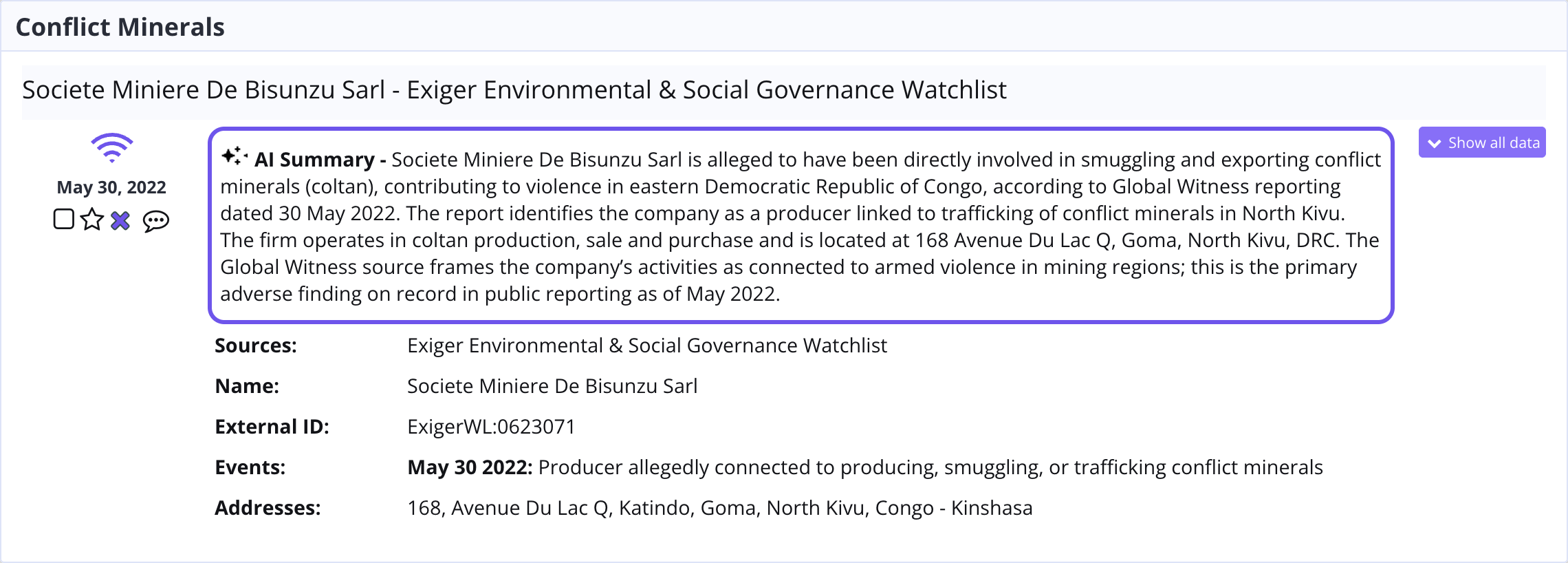
(Source: 1Exiger.AI) EXIGER’S CONFLICT MINERALS WATCHLIST FLAGGED RUBAYA’S OPERATOR BEFORE M23 TAKEOVER
Twangiza, the Banro-legacy gold mine in Sud-Kivu now operated as a joint venture between Shomka Capital and Chinese-owned Baiyin International Investments, suspended operations on May 8, 2025 following directives from the newly installed M23 administration of South Kivu Province. The site has remained offline since.
Industry Impact
Consumer Electronics and Semiconductors
Tantalum holds charge in the solid-state capacitors built into virtually every smartphone, laptop, server, and connected device. The three largest tantalum capacitor manufacturers, KEMET (Yageo), AVX, and Vishay, collectively hold 60 to 70 percent of global market share, and source from a small number of qualifying smelters. Movement restrictions, quarantine zones, and possible suspension of artisanal processing centers may cause severe disruption on top of an already tight market driven by AI-related demand. Apple notified its suppliers in June 2024 to suspend 3TG sourcing from the DRC and Rwanda citing escalating regional conflict and the inability of independent auditors to perform required due diligence, setting a precedent for tech-sector withdrawal under conflict-financing concerns that other major tech companies have not publicly matched.
Defense and Aerospace
Tantalum and tungsten are on the USGS 2025 List of Critical Minerals, which the Department of War helped finalize through interagency review, and both are held in the National Defense Stockpile managed by the Defense Logistics Agency. Tantalum capacitors are essential to the radar, microelectronics, and missile defense systems produced by major US defense primes including RTX, Northrop Grumman, L3Harris, and BAE Systems. Tungsten heavy alloys are widely used in kinetic energy penetrators and armor-piercing munitions. Gold is widely used as plating for high-reliability connectors in avionics, radar, and missile guidance systems. Prime contractors should assess whether current Responsible Minerals Assurance Process (RMAP) certifications remain valid under outbreak conditions, particularly for 3TG sourced from affected provinces.
Electric Vehicle and Battery Supply Chains
The DRC’s cobalt and copper production, which feeds cathode materials used by CATL, LG Energy Solution, and Panasonic for automakers including Volkswagen and Stellantis, originates in Lualaba and Haut-Katanga, more than 1,500 km south of the current outbreak. The indirect risk is twofold. First, DRC copper and cobalt miners are already rationing leaching chemicals after Iran-conflict shipping disruptions cut sulfuric acid and sulfur deliveries through Hormuz, with Goldman Sachs estimating DRC copper output could be cut by 125,000 tonnes in 2026 if disruptions persist. Second, the Lobito Corridor and TAZARA railway are the rail transit routes for Copperbelt exports, and Dar es Salaam container volumes have nearly doubled as shipments reroute. Manufacturers with just-in-time inventory should model a four-to-eight week corridor disruption scenario.
Compliance Implications
The current outbreak sits at the precise intersection of multiple active regulatory regimes. Companies with 3TG in their supply chains should assess their exposure against each of the following:
| Regulatory Framework | Exiger Analysis |
|---|---|
| Dodd-Frank Act §1502 (SEC) | Conflict Minerals Rule requires reasonable country-of-origin inquiry and due diligence for 3TG from DRC and adjoining countries. An Ebola overlay on active M23 control of Rubaya coltan and suspended artisanal processing centers significantly raises the evidentiary bar for “DRC Conflict-Free” determinations. |
| EU Conflict Minerals Regulation (2017/821) | EU importers of tin, tantalum, tungsten, and gold above volume thresholds (cassiterite 100t, coltan 2t, wolframite 20t, unwrought gold 100kg/year per Delegated Regulation 2020/1588) must conduct OECD-aligned due diligence. Supply disruption in affected provinces increases the likelihood that non-compliant material is co-mingled with legitimate supply as traceability systems fail. |
| OECD Due Diligence Guidance (3rd ed.) | Annex II “red flag” indicators include: sourcing from areas of armed conflict, using transport/trading routes with known militia involvement, and working with artisanal miners in areas of poor governance. All three apply to eastern DRC’s current situation with greater intensity during the outbreak. |
| US–DRC Strategic Partnership Agreement (2025) | The SPA commits DRC to formalizing artisanal mining and improving chain-of-custody as conditions for preferential US market access arrangements. The DRC government’s suspension of artisanal processing centers during the outbreak may be read as either a public health measure or a compliance regression, depending on how US interagency bodies interpret it. |
| ITSCI and RMI Bagging & Tagging | Field-level traceability programs (ITSCI, RMAP, Better Sourcing Program) operate in North Kivu and Ituri. Outbreak conditions—quarantine zones, movement restrictions, insecurity—directly undermine the in-person verification on which these systems depend. Smelters relying on RMAP certification from affected areas should request enhanced supplier declarations. |
What Organizations Should Do Now
- Initiate or accelerate supplier mapping for any 3TG-containing products with DRC supply chain exposure. Focus on tier-2 and tier-3 smelter and refinery relationships, which is where outbreak-driven traceability gaps will surface first.
- Update conflict minerals due diligence questionnaires. Include specific inquiries about supply from Ituri, North Kivu, and South Kivu provinces. Document the inquiry trail now, before the annual conflict minerals reporting cycle.
- Vet alternative suppliers against regulatory, sanctions, and compliance databases before onboarding. Exiger’s continuous third-party risk management (TPRM) monitoring identifies regulatory violations, sanctions exposure, and adverse media against new and existing suppliers, so risk surfaces before a relationship is onboarded rather than after.
- For EV and battery supply chains, stress-test the Lobito Corridor assumption in your logistics risk models. While cobalt and copper mines are currently unaffected, the export infrastructure is worth monitoring as deteriorating security in eastern DRC has historically prompted movement restrictions that cascade nationally.
- Conduct a dedicated government affairs review. Organizations with exposure under the US-DRC Strategic Partnership Agreement or tracking USMCA/IEEPA considerations in the broader DRC mineral context warrant a focused review. Exiger will continue to monitor the outbreak and provide updates as developments unfold, including geographic spread, DRC government mining decrees, M23 territorial movement, and any disruption at Barrick’s Kibali mine in Haut-Uele.
How Exiger Can Help
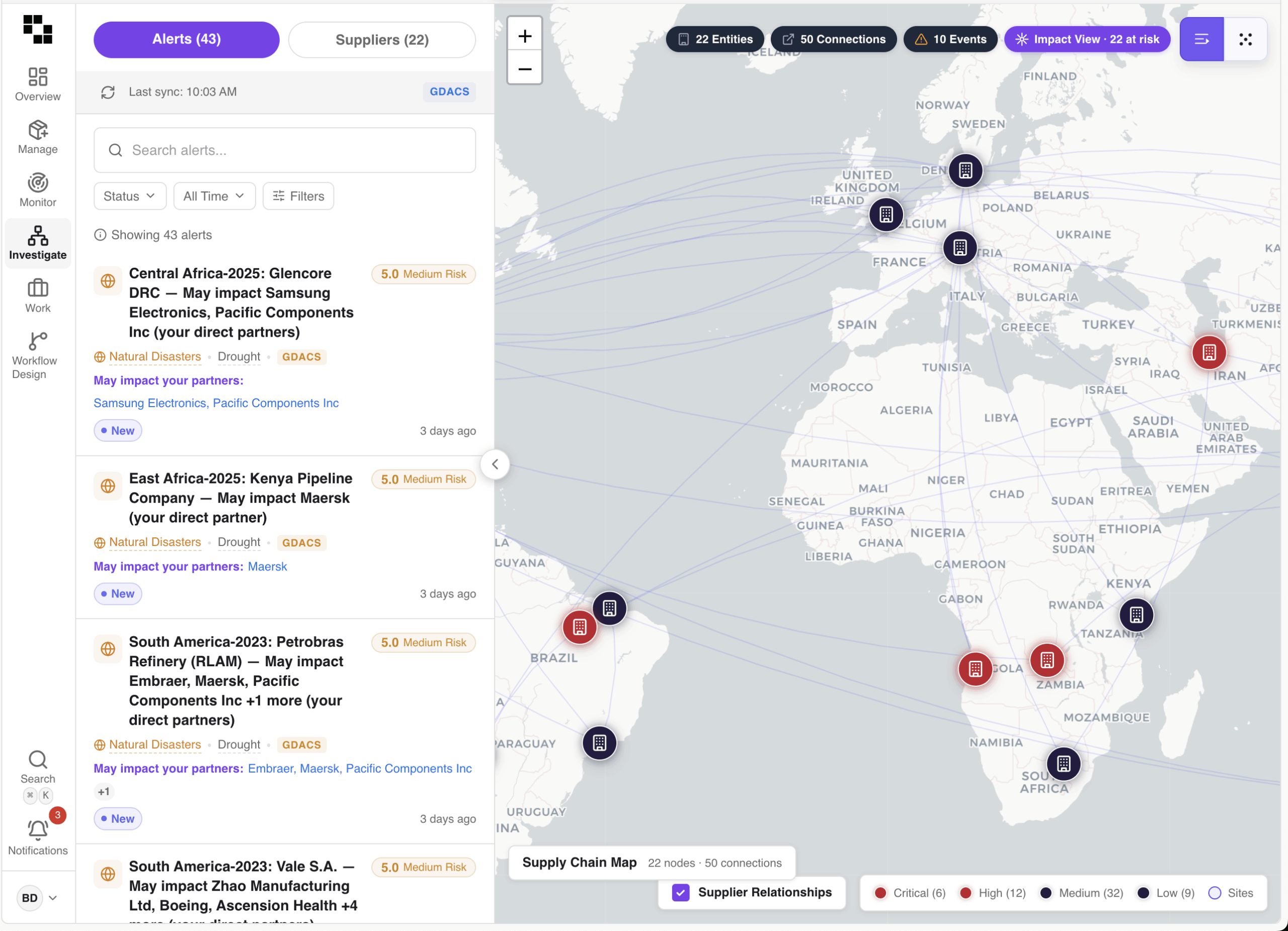
Supply Chain Exposure Mapping
Uses our AI and ontology to connect relationships across suppliers, sites, materials, and upstream dependencies; helping teams understand if and how their networks are exposed.
Screenshot: a detailed view of your global network and how disruption events may impact trade flow. (Source: 1Exiger.AI)
Dependency and Concentration Analysis
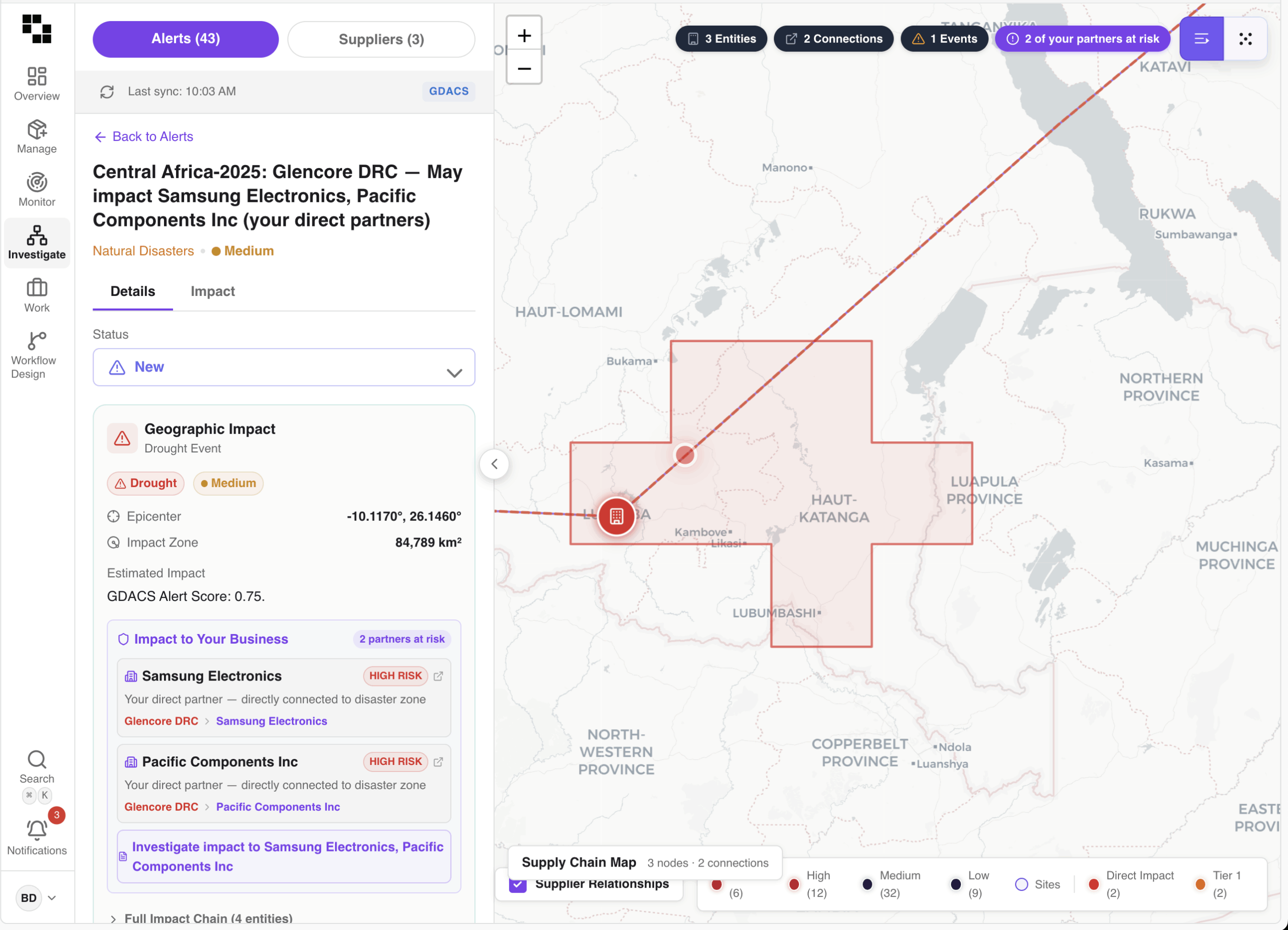
Identifies single points of failure across suppliers, sites, ports, and routes, and ranks where concentration creates outsized operational risk.
Screenshot: 1Exiger.AI identifies critical chokepoints, even in the sub-tiers, that may be impacted by disruption events. (Source: 1Exiger.AI)
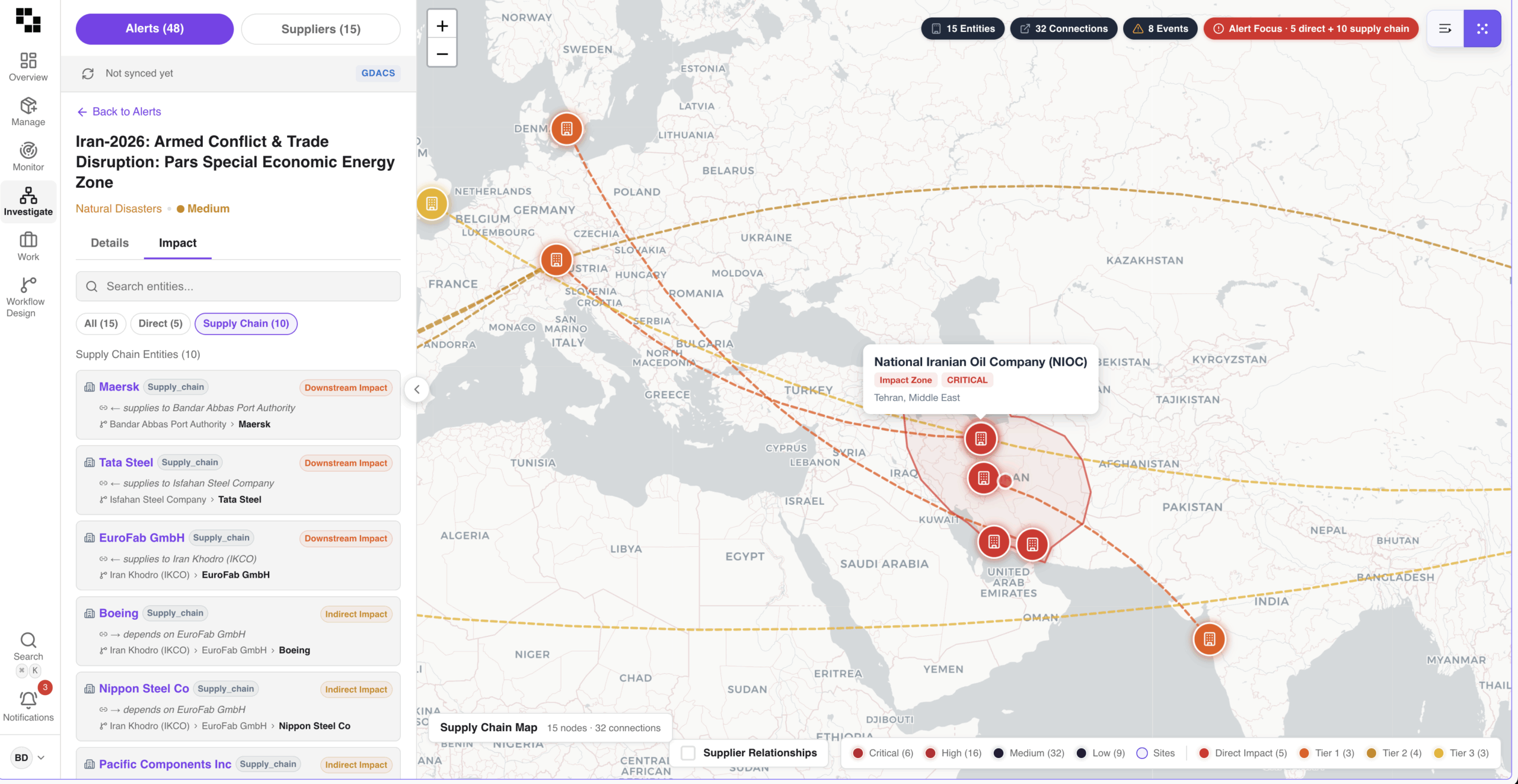
Screenshot: see projected downstream impact from disruption events at every tier. (Source: 1Exiger.AI)
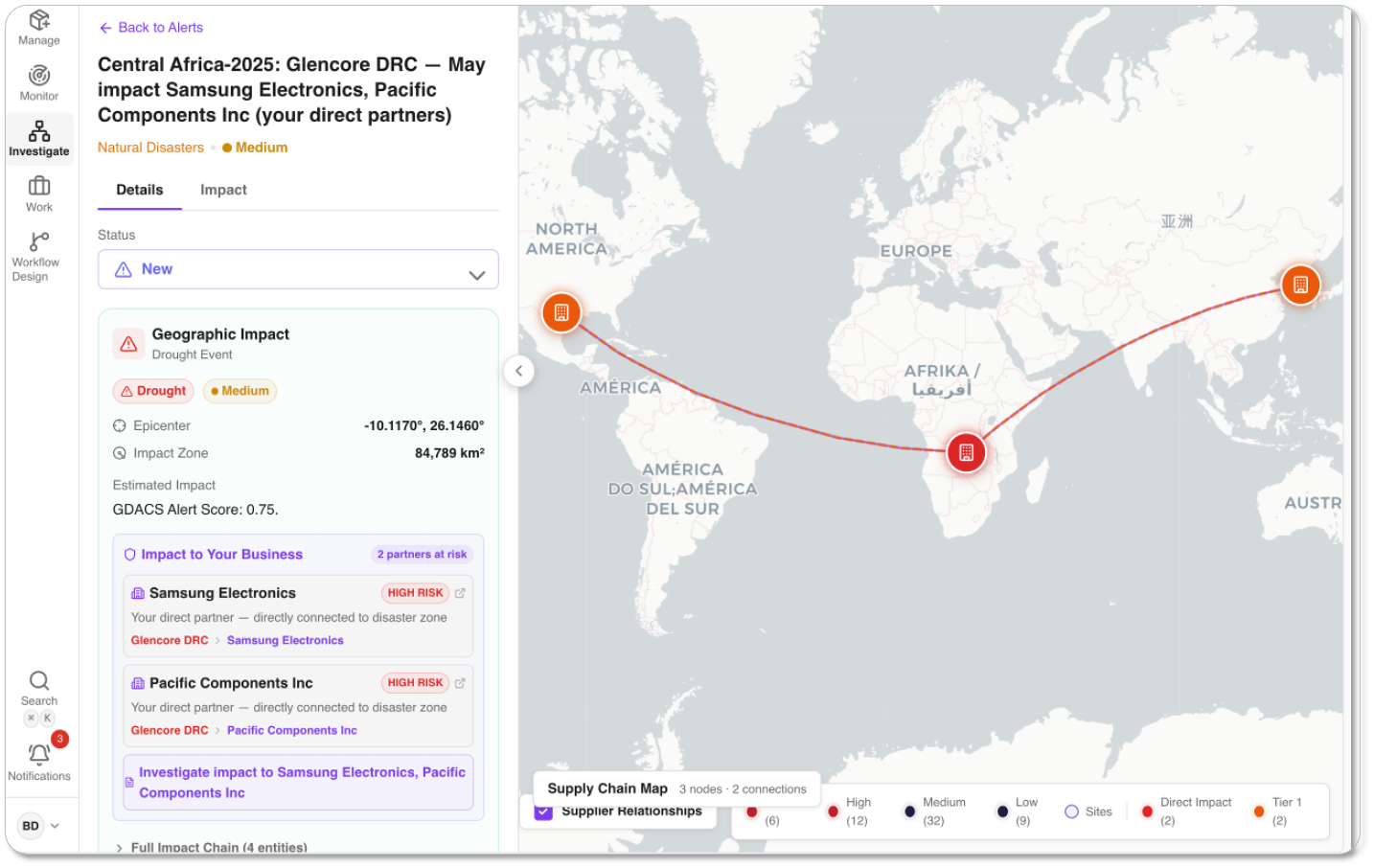
Scenario Modeling and Sensitivity Testing
Models disruption scenarios to quantify downstream impact, stress-test resilience, and compare mitigation strategies across suppliers, parts, and materials.
Screenshot: model impact for various conditions and receive recommended courses of action.
(Source: 1Exiger.AI)
Unified Risk Governance and Response Workflows
Creates a shared “war room” view with ownership, escalation, and tracked mitigation actions across procurement, logistics, compliance, and leadership.
Screenshot: custom workflows and agentic AI connect cross functional teams and execute remediations to prevent disruption. (Source: 1Exiger.AI)
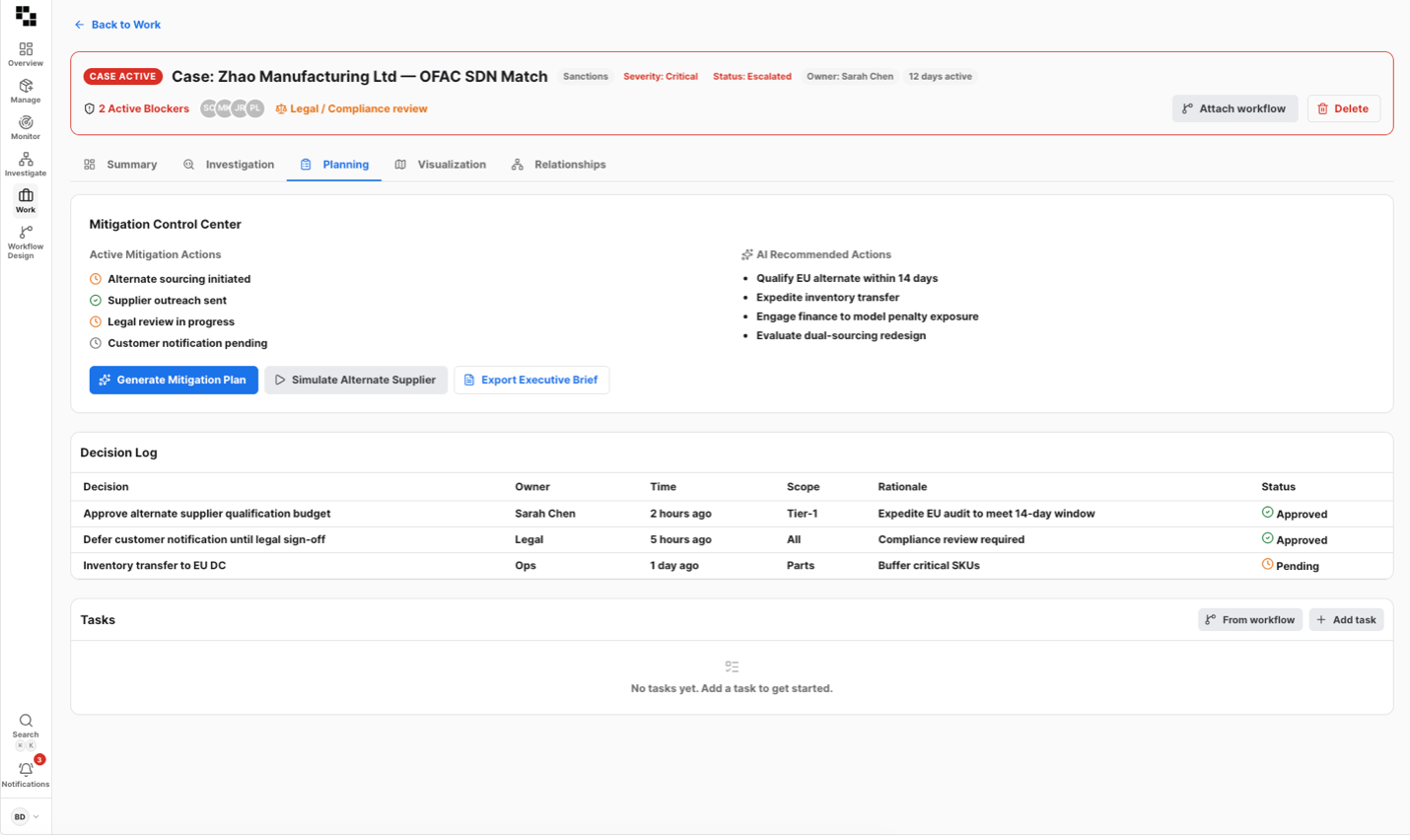
Get an Exposure Assessment
Contact us or reach out to your Customer Success Manager to get started.
Table of Contents
Get in Touch
Learn how you can build a more resilient supply chain.


